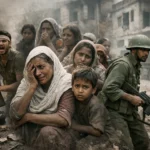
The recent statement by Bangladesh’s Prime Minister, Tarique Rahman, on March 25, 2026, has once again brought the tragic history of 1971 to the forefront of regional diplomacy. Observing “Genocide Day,” the Prime Minister issued a poignant message on social media platform X, stating:
“In the history of freedom loving Bangladesh, 25 March 1971 remains one of the most disgraceful and brutal days. The Pakistani occupation forces carried out one of the most heinous genocides in history against the unarmed people of Bangladesh in the name of ‘Operation Searchlight’.”
While the Prime Minister’s condolences for the martyrs are understandable, his assertion that the events were a “pre-planned massacre” reinforces a singular narrative that risks oversimplifying a deeply complex conflict.
A holistic view of history reveals that violence did not begin on March 25. Following the postponement of the National Assembly on March 1, 1971, East Pakistan descended into weeks of lawlessness. During this period, organized mobs targeted the Bihari community and other non-Bengali minorities. In cities like Chittagong and Khulna, thousands of innocent civilians who were not part of any combat, were murdered well before Operation Searchlight was launched.
Furthermore, any objective analysis must acknowledge the role of external instigation. India’s active support for separatist elements and the training of the Mukti Bahini long before the outbreak of full-scale war are well documented facts that demonstrate a calibrated effort to destabilize Pakistan’s territorial integrity.
The tragedy of 1971 was multifaceted. By focusing exclusively on the military response that was a pre-emptive campaign undertaken to maintain writ of the state, the current leadership in Dhaka overlooks the “ethnic cleansing” of those who remained loyal to a united Pakistan. Selective memory that blames Pakistan in isolation is not only historically unjust but also ignores the internal uprising and foreign interference that catalysed the conflict.
In response to these recent diplomatic signals, Pakistan’s leadership has consistently advocated for a forward-looking approach. The Prime Minister of Pakistan has frequently pointed to the 1974 Tripartite Agreement as the legal and moral roadmap for our bilateral ties. This agreement was signed by the founders of both nations with the explicit intent to “forget the past and look into the future”. Islamabad maintains that true reconciliation requires an honest accounting of all victims; Bengali and non-Bengali alike. Digging up a selective version of the past serves only to stall the regional cooperation necessary for a prosperous South Asia.