President Donald Trump’s decision of imposing preliminary countervailing duties of 126% on Indian solar imports has led to another trade crisis between India and the United states. This move is announced to counter the skyrocketing exports to the US because of unfair government subsidies that Indian manufacturer benefit. The timing of this decision can derail a high-stakes trade deal and could cast a shadow over a recently signed trade framework intended to overcome economic tension between the two states.
The bilateral trade agreement between India and the United states under Trump’s tariffs imposition has come under intense scrutiny and criticism from Indian opposition and public for being lopsided. In the trade deal, India committed to $500 billion worth of US imports, moreover, it agreed to eliminate tariffs on American agricultural and industrial goods.
On the contrary, Indian goods exported to the US saw their tariff rates from none to 18%, before the newest solar import tariffs. The opposition leader, Rahul Gandhi, has vehemently condemned Indian government’s decisions at the behest of the Trump administration, calling it surrender to US geopolitical interests. For instance, the Indian government has agreed to halt Russian oil purchases and exit from the Chahbahar port project with zero investment plans in its latest Budget 2026.
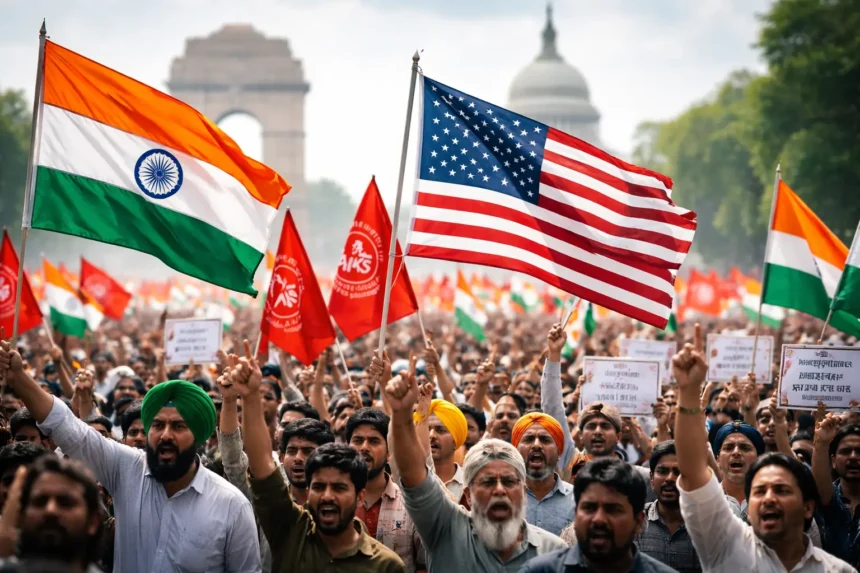
The deal has also brought anger in the Indian public with massive nation-wide strikes from workers, farmers and students, flooding the streets across India. Unions like the Samyukta Kisan Morcha has labeled the deal as a surrender as it would flood Indian markets with cheap US products, destroying the livelihoods of millions of Indian farmers. Furthermore, president’s Trump’s blunt statement about the deal as a flip where India will pay tariffs have also brought backlash from Indians. Meanwhile, there is a profound uncertainty regarding the trade deal as the US Supreme Court has also struck down some of the Trump administration’s tariff measures.