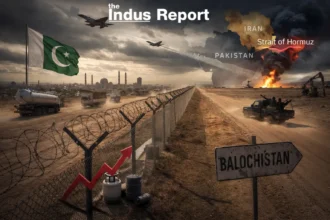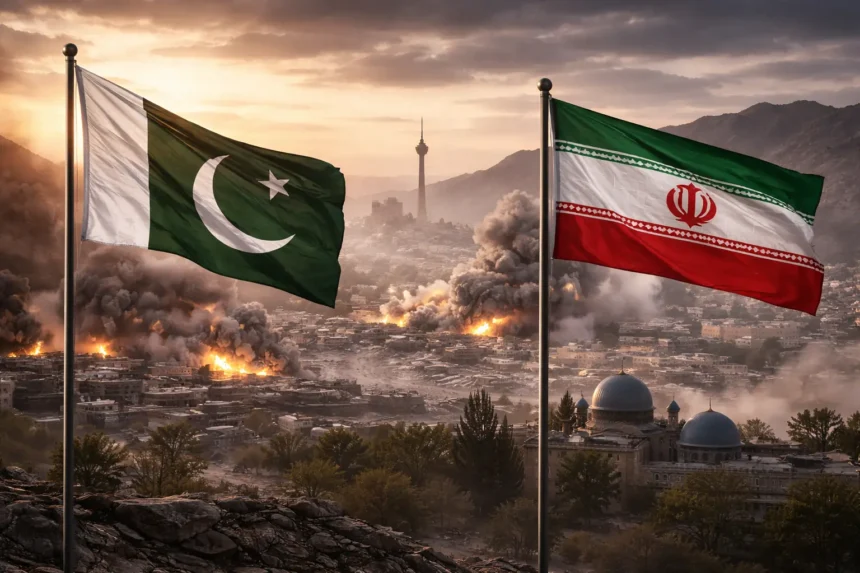
The geopolitical landscape of West and South Asia is undergoing a seismic shift.
Recent so called “Pre-emptive Strikes” by US- Israel coalition has left Iran in
shambles which in response targeted US bases stationed in countries across the
gulf. Amid these erupting dynamics, Pakistan and Iran are entering one of the
most complex phases in their bilateral relationship in decades. This evolution is
not a product of diplomatic courtesy but a response to a rapidly realigning world
where countries like USA, Saudi Arabia, UAE, Qatar, Israel, China, and India are
all recalibrating their regional footprints. In this power struggle for regional
dominance and global relevance, Pakistan-Iran relation stand at a strategic
flashpoint.
The roots of the Pakistan-Iran relationship run very deep which are embedded
in profuse cultural and religious domains. Iran was the first country to recognise
the existence of Pakistan on August 14, 1947, and hosted Pakistan’s inaugural
embassy abroad. Over the decades, the two neighbours have avoided any major
territorial or political disputes. The cultural and religious connections, coupled
with geographic contiguity and a long border linking Pakistan’s Balochistan
province with Iran’s Sistan-Balochistan region best describe the entirety of this
bond; providing a durable foundation for engagement. Despite occasional
irritants, both the governments consistently emphasise dialogue and
cooperation for addressing differences and strengthening mutual
understanding.
However, the tangible economic and energy cooperation remained far below its
perceived potential. While political goodwill was strong, structural constraints
inhibited the expansion in trade and investment sector. One of the factors being
the external pressures, particularly US led sanctions on Iran which were
significant barriers to financial transactions and cross-border investment.
Sanctions discouraged large-scale commercial engagement and complicated
banking channels, while periodic security incidents along the border further
raised concerns about stability. Nevertheless, Pakistan and Iran are committed
to reiterate that the positives of the relationship outweigh the negatives. Both
governments recognise that pragmatic engagement in areas such as energy
security, trade facilitation and regional stability can boost mutual benefits and
strengthen long-term ties.
February 28, 2026 has fundamentally altered the geopolitical equation of
Southwest Asia. The confirmed death of Iran’s Supreme Leader, Ayatollah Ali
Khamenei, following a series of coordinated US – Israeli airstrikes, plunged the
region into a state of catastrophe. With political future of Iran as unknown
coupled with intermittent attacks by US – Israel and volatility in Gulf states, from
Pakistani perspective this is not just a neighbour’s tragedy it is a strategic
emergency.
The assassination of Khamenei represents a “decapitation strike” intended to
trigger systemic change. In the Iranian theocracy, the Supreme Leader is not just
a political figure but the Commander-in-Chief and the ultimate arbiter of all state
matters. His absence creates an immediate constitutional and security vacuum.
Under Article 111 of the Iranian Constitution, an interim council which is typically
led by the President, the Head of the Judiciary, and a Guardian Council member
assumes control. However, the real battle lies within the Assembly of Experts.
Hardliners within the IRGC may push for a strict security-first model to preserve
the Islamic Republic’s authority. The dynastic path, centred on Mojtaba
Khamenei, could consolidate power but risks deepening internal divisions.
Pragmatist factions may seek stability through a more diplomatic posture to
deter Western intervention. Each path reflects a struggle between survival,
legitimacy, and international pressure. For Pakistan, the risk of a fractured
leadership in Iran is a “black swan” event. A decapacitated Iran could lead to a
total loss of control over militant groups operating across the Sistan- Balochistan
border, undermining Pakistan’s internal security.
On February 28, 2026, Pakistan’s Foreign Office (FO) issued a stern
condemnation of the “unwarranted attacks” on Iran. Islamabad views the
targeted assassination of a head of state as a “blatant violation of international
law.” Pakistan fears that if such strikes go unchecked, a “law of the jungle” will
prevail replacing the existing global order; a dangerous proposition for all
sovereign nations.
In a move that now seems prophetic, Pakistan has accelerated the end of the
“Rahdari” (one-document) system along the border. This requires all travellers
to possess valid passports and visas, effectively ending decades of informal
crossing thus institutionalizing the border crossings. The Iran-Pakistan (IP) Gas
Pipeline, once the cornerstone of bilateral energy security, is effectively on life
support. With the U.S. likely to impose a “total blockade” of sanctions on any
post-Khamenei entity, Pakistan’s Special Investment Facilitation Council (SIFC)
is already pivoting towards Omani and Qatari LNG to fill the energy gap.
Despite the chaos, Pakistan is making committed endeavours to position itself
as a neutral mediator. Prime Minister Shehbaz Sharif has called for an emergency
session of the OIC (Organization of Islamic Cooperation) to prevent a looming
threat of Sunni-Shia regional war. Pakistan’s future strategy is defined by
Aggressive Neutrality: –
- No Foreign Bases: Islamabad has reiterated that Pakistani soil will not be
used for strikes against Iran. - No Proxy Involvement: Pakistan has resisted pressure to join any
“Coalition of the Willing” against the IRGC. - Regional De-escalation: Working with China and Turkey to create a
“Stability Corridor” that prevents the total collapse of the Iranian state.
The reaction to this crisis varies significantly across the region. While Pakistan
has formally condemned the assassination as an “Illegitimate Act” and moved to
secure its borders, other actors have taken different paths. Saudi Arabia and the
UAE have maintained a cautious official silence regarding the death itself while
actively intercepting Iranian retaliatory missiles. Meanwhile, the United States
and Israel have framed the event as the “end of an era of terror,” reasserting its
military pressure to quell the Iranian regime. Conversely, China has expressed
“Deep Concern,” calling for a restrained succession process to protect its
investments in the region, particularly those linked to the Belt and Road
Initiative.
The death of the Supreme Leader has not ended the conflict; it has merely
changed its nature. Pakistan’s challenge is to ensure that the fire in its
neighbour’s house does not burn down its own. As the world watches Iran,
Pakistan is watching the border, knowing that in 2026, there are no more “safe”
distances in geopolitics.