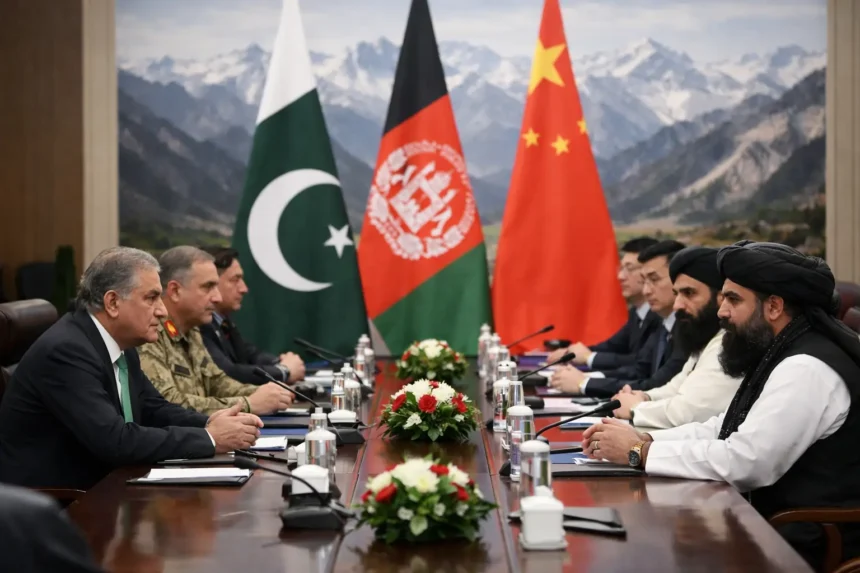
As the Urumqi dialogue enters its second day in north-western China, the diplomatic atmosphere in Islamabad is one of a calculated pragmatism. While Reuters and other international outlets frame these talks as a “Beijing brokered” peace effort, the Pakistani perspective reinforced by senior officials in The Express Tribune is clear; This is not a concession, but an exploratory attempt to force a verifiable mechanism from a recalcitrant Kabul.
For Pakistan, the return of the Taliban in 2021 has not yielded the expected strategic depth but rather a strategic deficit. Islamabad’s core grievance remains the sanctuary provided to the Tehrik-i-Taliban Pakistan (TTP). Despite the Taliban’s reported willingness in Urumqi to offer written guarantees that Afghan soil will not be used for terrorism, Pakistani officials told Dawn that “mere words no longer suffice.” The ongoing “Ghazab Lil Haq” military operation remains active, signalling that Islamabad will not pause its counter terrorism kinetic efforts until there is visible evidence of the Taliban dismantling militant infrastructure.
From the viewpoint of the Pakistani Foreign Office, China’s role is that of a “mutually supplementary” partner rather than a neutral arbiter. As The Economist has noted, the security of the China Pakistan Economic Corridor (CPEC) is a shared priority. Islamabad views Chinese mediation as a way to hold the Taliban accountable to their international commitments.
The current crisis, which peaked after the retaliatory Pakistani airstrikes against militant hideouts in Kandahar and Khost, has redefined the bilateral relationship. No longer is Pakistan willing to overlook cross border incursions in the name of brotherly relations. As reported by The News International, the expectation from these talks is not just a ceasefire, but the reopening of trade routes like Chaman and Torkham under a framework where security takes precedence over commerce.
Ultimately, Islamabad’s stance in 2026 is one of “trust but verify.” The Urumqi talks represent a diplomatic window, but for Pakistan, the door to normalization remains locked until Kabul demonstrates the political will to govern its borderlands effectively.