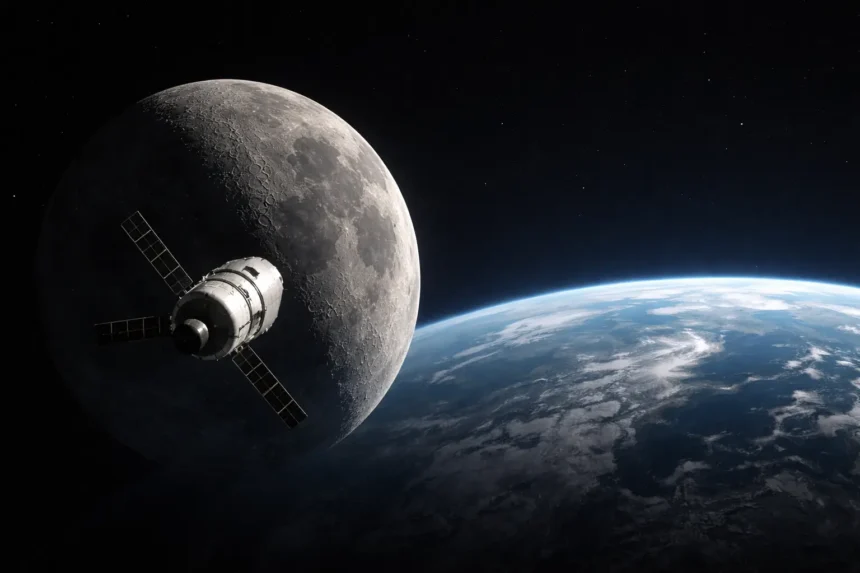
The successful launch of Artemis II on April 1, 2026, marks the definitive return of human presence to deep space. As the first crewed mission to the Moon in over half a century, it serves as the ultimate “shakedown cruise” for NASA’s Space Launch System (SLS) and the Orion spacecraft.
Following a high velocity lift-off from Kennedy Space Centre, the crew Commander Reid Wiseman, Pilot Victor Glover, and Mission Specialists Christina Koch and Jeremy Hansen began a 24 hour checkout period in High Earth Orbit. According to The New York Times, this phase is critical for testing life support systems and manual piloting manoeuvres.
Once cleared, the Orion Service Module will execute the Trans Lunar Injection (TLI) burn. This four day transit will propel the crew toward the Moon. Unlike the Apollo missions that entered lunar orbit, Artemis II utilizes a “free return trajectory.” As noted by The Economist, the spacecraft will loop around the lunar far side at an altitude of approximately 4,600 miles (7,400 km), using the Moon’s gravity as a “slingshot” to pull Orion back towards Earth without a secondary major engine burn.
The mission is expected to conclude on April 10, 2026. The Financial Times reports that the return sequence will be a historic stress test, as Orion re-enters the atmosphere at nearly 25,000 mph (40,000 km/h), the fastest re-entry for a crewed vehicle. The capsule is slated to splash down in the Pacific Ocean off the coast of San Diego, where U.S. Navy recovery teams are already positioned.
Artemis II is the gateway to Artemis III, which NASA has recently rescheduled for 2027. While the original goal was a lunar landing, updated reports indicate that Artemis III will now focus on docking and rendezvous tests in Low Earth Orbit with SpaceX’s Starship HLS. This phased approach ensures that the infrastructure for a permanent lunar base and eventually, a human mission to Mars is rigorously validated before the first woman and person of colour step onto the lunar regolith later this decade.