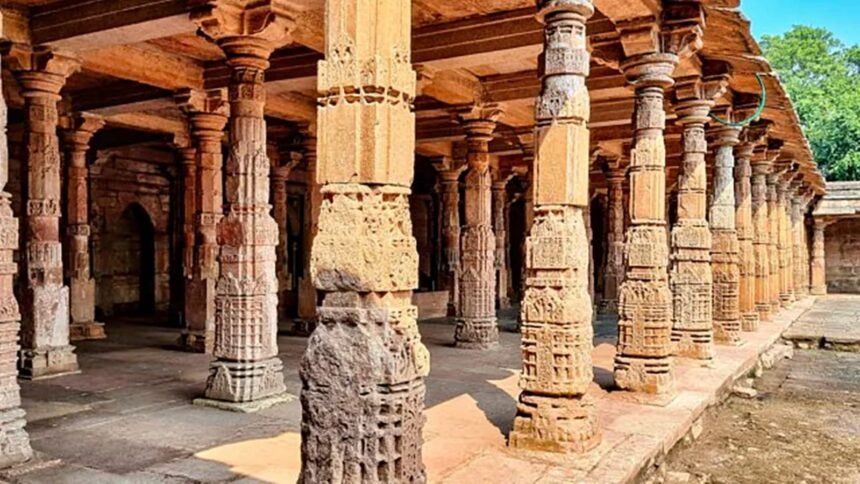
Another step in shifting landscape of India from secularist nature to a Hindu Rashtra is taken by an Indian High Court while declaring the medieval Kamal Maula mosque to be Bhojshala temple, dedicated to a Hindu goddess. This judicial decision bans Muslims from performing prayers from centuries at the mosque located in Madhya Pradesh. The verdict of the High Court is not an isolated legal dispute; rather it is another milestone in an ideological campaign aimed at dismantling Islamic heritage under the prevailing Hindutva regime. This court decision has further provided ground in inching the nation closer to Rashtriya Swayamsevak Sangh’s (RSS) ideological objective of a Hindu Rashtra.
The Bhojshala-Kamal Maula mosque existed under a shared arrangement between Hindus and Muslims for decades. Under the guidelines of the Archaeological Survey of India (ASI), Muslims were permitted to offer Friday prayers, while Hindus worshipped at the site on Tuesdays. The court has completely barred Muslims from offering prayers in the complex as this decision effectively erases centuries of cohabitation while establishing an absolute Hindu dominance over the historic site.
This legal action reflects the historic decision of Babri Masjid case, which culminated in the demolition of the historic mosque and the subsequent construction of the ram Mandir. The success over the Babri Masjid has served as a catalyst for the right-wing Hindutva groups to increasingly turn to the saffronized judiciary to petition against numerous other historical mosques across India. For instance, the Gyanwapi Mosque in Varanasi and the Shahi Idgah in Mathura also reflect the same pattern.
It is observed that the judiciary which was once viewed as a bulwark of constitutional secularism is now increasingly aligning with the political imperatives of the ruling majoritarian community. By saffronizing judiciary with court-ordered archeological surveys and legal revisions, the Hindutva ruled state has found a sophisticated mechanism to re-write the history. Therefore, these decisions clearly reflect that the historical, cultural and religious footprints of minority communities, specifically Muslims, are subject to legal revocation.
The pluralistic nature of India is in an unprecedented crisis because the legal system continues to validate the claims of Hindutva ideology. This ideology is using all means to eradicate Islamic heritage as the conversion of the Kamal Maula mosque marks yet another step. Therefore, these actions are transforming India from a constitutional democracy into a majoritarian state where culture dominance of Hinduism is institutionalized by law.