The Strait of Hormuz has long been synonymous with global energy security. Now, another strategic waterway is emerging as the Middle East’s newest flashpoint.
According to three senior Iranian and regional sources who spoke to Reuters, Tehran has instructed Yemen’s Houthi movement to prepare to shut the Bab al-Mandeb Strait if the United States launches strikes against Iran’s power infrastructure. The reported contingency plan signals that Iran may be prepared to expand pressure beyond the Persian Gulf, threatening two of the world’s most important maritime chokepoints simultaneously.
The warning gained further weight after Yemeni Foreign Minister-designate Afrah Al-Zouba said the Houthis were seeking to replicate Iran’s strategy in the Strait of Hormuz.
“The Houthis want to copy the Iranian model and this will shut down two main straits, the gateways into the Gulf and Red Sea,” Al-Zouba told journalists in Riyadh.
Why Bab al-Mandeb matters
The Bab al-Mandeb Strait lies between Yemen on the Arabian Peninsula and Djibouti and Eritrea in the Horn of Africa. Although only about 30 kilometres wide at its narrowest point, it serves as the southern entrance to the Red Sea and the Suez Canal.
Every year, billions of pounds worth of trade—including crude oil, liquefied natural gas and container cargo—passes through this corridor connecting Asia, Europe and the Mediterranean. Any prolonged disruption would force ships to sail around the Cape of Good Hope, adding thousands of kilometres to voyages, increasing fuel costs, insurance premiums and delivery times.
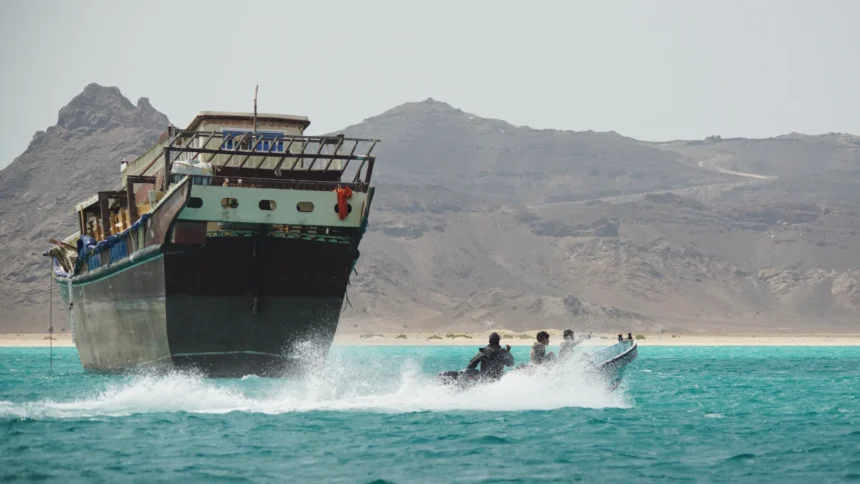
The strait has already witnessed repeated Houthi missile and drone attacks on commercial vessels since the Gaza war, causing many shipping companies to divert routes. A complete closure, however, would represent an unprecedented escalation with global economic consequences.
Can the Houthis actually shut it?
Unlike Iran’s direct control over the Strait of Hormuz, the Houthis do not physically control Bab al-Mandeb. The waterway borders several countries and is patrolled by international naval forces.
However, analysts note that the Houthis do not necessarily need to block the strait completely to make it commercially unusable. Sustained missile launches, drone attacks and threats against merchant vessels could raise the security risk to a level where shipping companies voluntarily avoid the route—as has happened previously in the Red Sea.
According to reports some vessels have already altered course following renewed Houthi threats, illustrating how even limited attacks can disrupt global trade.
A new phase of deterrence
Whether the Houthis ultimately act may depend on Washington’s next move. The reported Iranian instruction is conditional—linked specifically to any US strike on Iran’s electricity infrastructure.
For Tehran, the strategy reflects a broader doctrine of asymmetric deterrence: using allied groups across the region to impose costs on adversaries without engaging in direct confrontation.
If the Strait of Hormuz remains under pressure while Bab al-Mandeb also becomes unstable, global shipping would face disruption at both ends of the Arabian Peninsula. Such a scenario would affect energy markets, international trade and regional security far beyond the Middle East.
For now, Bab al-Mandeb remains open. But the latest warnings suggest that the strategic contest is no longer confined to Hormuz—the Red Sea gateway may now be the next front.