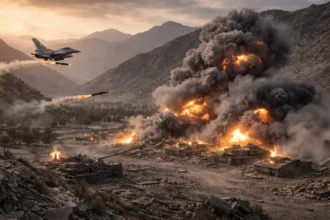
Netflix’s biggest Indian production to date Operation Safed Sagar, arrives as a six-part war drama built around fighter pilots, political manoeuvring and the Indian Air Force’s role in the 1999 Kargil War. The series follows a brotherhood of pilots as they fight an aerial campaign at extreme altitude while political and military decisions unfold behind the scenes. Netflix presents it as the story of the Indian Air Force’s role in what became the world’s highest air operation, a chapter of Kargil that has received considerably less cinematic attention than the Army’s battlefield experience.
On the surface, it is another patriotic war drama. But its timing makes it far more revealing.
Operation Safed Sagar comes after Operation Sindoor, an episode of a serious challenge to India’s carefully cultivated image of overwhelming air superiority. The confrontation resulted in the loss of six Indian military aircraft and demonstrated that India’s technologically advanced air force was far from invulnerable. The episode became a major blow to the narrative of unquestioned Indian dominance in the skies. Now, one of Netflix’s largest Indian productions is taking audiences back to another conflict and another story of Indian aerial success.
How quickly the industry moves to convert real conflict into content is itself telling. Within hours of the actual May 2025 strikes, producers were already racing to register the title “Operation Sindoor” — one industry body alone fielded a dozen applications — and at least one studio put out a poster for a film with no cast and no script while the operation was still underway. Safed Sagar, for its part, was unveiled not at a film festival but at an Indian Air Force marathon event in New Delhi, and was made with direct IAF cooperation, filmed on operational air bases with access to real aircraft. The line between commemoration and campaign becomes hard to locate.
That raises an obvious question: why is Indian cinema so persistently preoccupied with Pakistan?
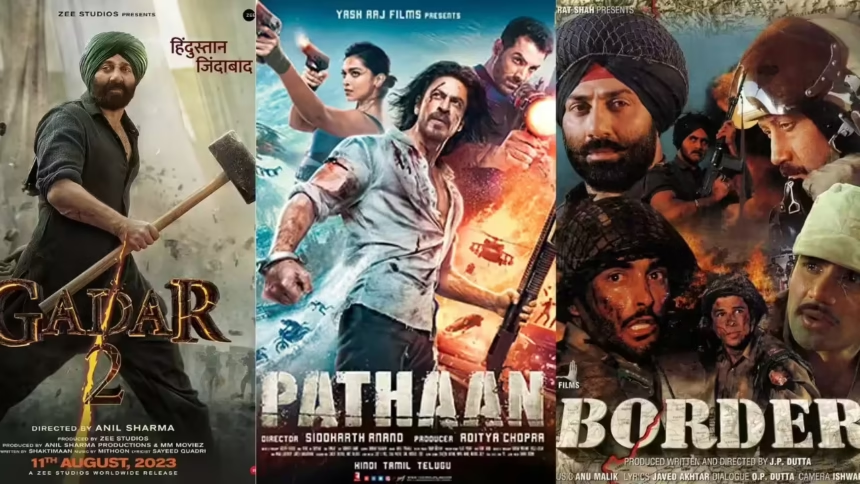
The pattern is hardly new. Mission Majnu, Dhurandhar, Raazi, Uri, Shershaah, Fighter and numerous other productions repeatedly place Pakistan at the centre of India’s cinematic security narrative. Pakistan becomes the spy network, the terrorist threat, the military antagonist or the battlefield against which Indian heroism is demonstrated. This obsession has become so pronounced that it has even attracted criticism from outside Pakistan. As one Guardian commentary observed, contemporary Bollywood villains are disproportionately Pakistani, often depicted through the familiar combination of military uniforms and Muslim identity, while other major strategic challenges receive comparatively little cinematic attention.
That tells us something about Bollywood: it has always reflected the political mood of India. The optimistic nationalism of the 1950s, the angry anti-establishment hero of the 1970s and the globalised yuppie of the 1990s all reflected their respective eras. In the Modi era, however, a substantial strand of mainstream cinema has embraced muscular nationalism, with Pakistan frequently occupying the role of permanent antagonist.
Consider Raazi, in which an Indian woman infiltrates a Pakistani military family as a spy, or Uri, which dramatizes India’s 2016 cross-border operation while taking considerable cinematic liberties with a highly contentious episode. The stories differ, but the underlying structure remains remarkably consistent: Pakistan provides the threat, India provides the hero and history becomes material to be reshaped for the requirements of a compelling national narrative. Operation Safed Sagar fits neatly into that tradition.
The problem is not that India makes patriotic films. The problem is repetition. When the same geopolitical adversary appears again and again, across spy thrillers, military dramas and blockbuster action films, cinema begins to do more than entertain. It conditions audiences to understand an entire conflict through a single lens. And Netflix changes the scale of that influence. A dramatized Indian version of Kargil can now be consumed by audiences around the world who may know little about the conflict beyond what appears on their screens. The distinction between historical record and cinematic storytelling becomes increasingly blurred.
This is why Safed Sagar should be viewed as a revisionist film, not simply another war spectacle. Its significance lies in the narrative it reinforces: Indian pilots as technologically superior heroes, Pakistan as the perpetual adversary and military history as a succession of Indian triumphs.
After Operation Sindoor, that narrative carries an additional significance.
When an uncomfortable contemporary episode raises questions about Indian air power, returning to a celebrated episode of Indian aerial warfare offers an easy cinematic antidote: remind audiences of the victories from their perspective. But fighter aircraft do not become more powerful because a screenplay says they are. Military history cannot be rewritten through spectacular aerial sequences, heroic monologues or repeated cinematic framing.
The genre persists because it is commercially dependable. Uri and Fighter each grossed well over ₹300 crore worldwide, and trade coverage of the post-Sindoor title rush noted plainly that films built on real military operations have a track record of major commercial success — which is exactly why producers wanted to be first in line. Not everyone in the industry is comfortable with this. Filmmaker Rakesh Omprakash Mehra has argued that genuine patriotism in cinema should promote peace and cross-border understanding rather than antagonism, and a retired Indian Army chief has publicly pushed back on the trend, saying war is not romantic and is not a Bollywood movie. Those are minority voices against a very profitable current.
Operation Safed Sagar may be entertaining. It may be technically impressive. But it is also part of something larger: a continuing war of narratives, carefully crafted to shape how younger generations understand a contested history, in which the battlefield increasingly extends from the skies to the cinema screen. And perhaps that explains the extraordinary attention. Pakistan is no longer merely an antagonist in Indian cinema. It has become a recurring character in the construction of India’s national story.