Pakistan has officially operationalized a strategic transit trade corridor through Iran, marking a significant shift in regional logistics as Islamabad seeks to bypass traditional, often disrupted routes through Afghanistan.
The National Logistics Corporation (NLC) has activated the Gabd border terminal under the International Road Transport (TIR) system. The move comes as Pakistan aggressively diversifies its export arteries to landlocked Central Asian states amid recurring border tensions and security closures on its northern frontier.
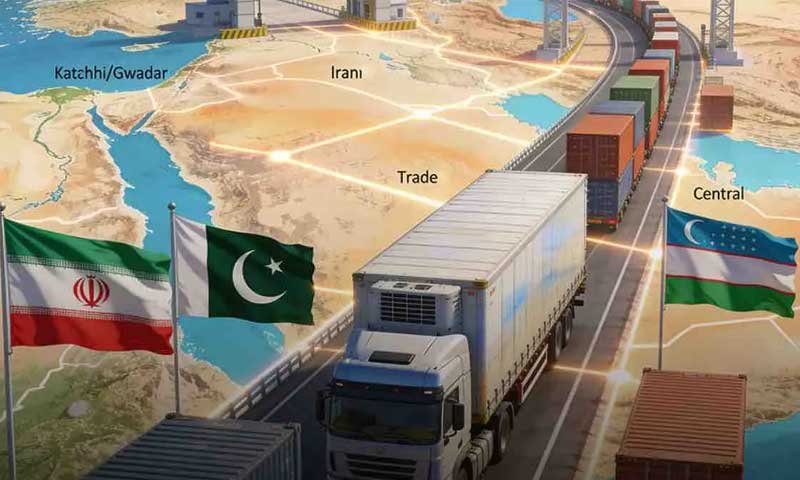
The inaugural shipment that consisted of refrigerated containers of frozen meat was dispatched from Karachi and cleared through the Gabd terminal in Balochistan. According to official reports, the convoy is enroute to Tashkent, Uzbekistan, traveling through Iranian territory under the TIR framework. This global system allows for seamless cross border movement with minimal customs checks and reduced administrative delays.
“This key milestone enables shorter, safer, and more modern access to Central Asia via Iran,” noted the NLC in a statement. The activation is seen as a tactical manoeuvre to provide a reliable permanent link between the Arabian Sea and the CIS markets.
The Gabd Rimdan border terminal that is located between Balochistan, Pakistan, and Iran’s Sistan-Balochistan province is now equipped with modern scanning systems and facilities capable of handling large volume of containerized cargo.
For Pakistan, this crossing is a cornerstone of its “geo-economic” strategy. Located in close proximity to the deep sea port of Gwadar, the crossing effectively integrates the China-Pakistan Economic Corridor (CPEC) with broader Middle Eastern trade networks. This Iran-Central Asia transit route serves as a vital “stop gap” solution to global supply chain disruptions affecting maritime routes like the Strait of Hormuz.
Uzbekistan has recently emerged as a primary market for Pakistani livestock products. Logistics experts suggest that the new Iranian route could reduce transit times and costs significantly, making Pakistani perishables more competitive.
Atif Ikram Sheikh, President of the Federation of Pakistan Chambers of Commerce and Industry (FPCCI), termed the initiative as a “remarkable achievement” that will open new avenues for regional economic integration. With this development, the NLC has now successfully activated multiple trade corridors connecting Pakistan to China, Iran, and various Central Asian states, signalling Islamabad’s intent to position itself as the primary logistics hub for the region.