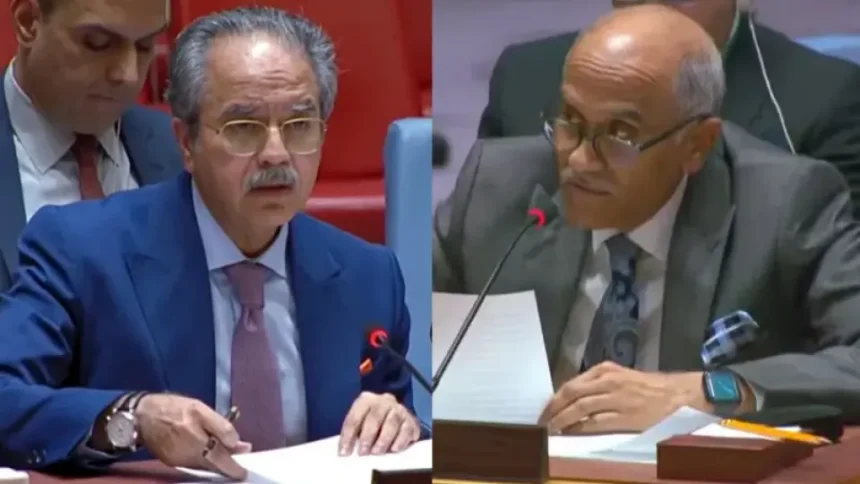
In a recent United Nations Security Council (UNSC) meeting, a blistering diplomatic confrontation between India and Pakistan exposed the deep-rooted animosities and shifting alliances in the South Asian region. At the heart of the discussion was the hot-blooded situation in Afghanistan, which has become a regional master-proxy conflict from a localized one. The issue amalgamated after Pakistan launched its Operation Ghazab Lil Haq against the surging tide of state-sponsored terrorism using Afghan soil and Indian support.
The accusations of trade and transit terrorism are introduced to characterize the current instability, suggesting that Pakistan is exploiting Afghanistan’s economic dependence to exert geopolitical pressure. However, these claims have no feet, as there is a proper terrorist franchise operating from Afghanistan under the master proxy of the Afghan Taliban. This franchise is funded by heavy foreign investment in order to destabilize Pakistan, while specifically targeting infrastructure and law enforcement.
Pakistan’s air and ground strikes are strictly aligned with international law, rooted in the inherent right to self-defense enshrined in Article 51 of the UN Charter. This is the response to the persistent and existential threat posed by mainly TTP and BLA to undermine the security and stability of the state. These strikes have also garnered recognition and support from regional and global powers. By neutralizing terror hide-outs that the local authorities of Afghanistan have failed to dismantle, Pakistan is acting as a frontline bulwark for the regional peace.
The ultimate objective of Pakistan is to have a peaceful Afghanistan, having de-facto regime fulfilling global commitments which include inclusive governance, the protection of women’s rights, and the cessation of its soil being used as a Launchpad for cross-border terrorism. Therefore, the only way to have a stable region is through precise counter-terrorism operations and the dismantling of foreign-sponsored militant networks, which Pakistan is now following as a means of punitive punishment.