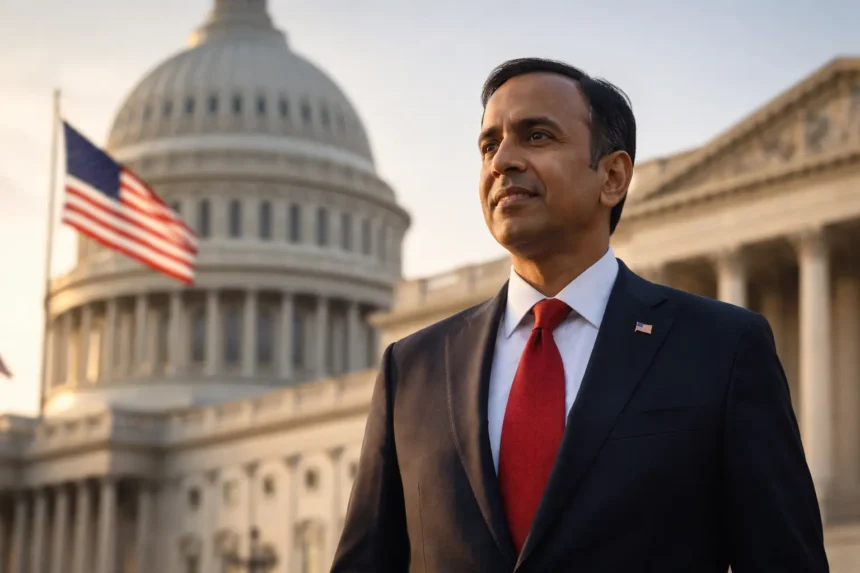
In the evolving tapestry of American domestic politics, the influence of the Indian American diaspora has moved beyond professional success to a sophisticated exercise of legislative power. At the centre of this transition is Congressman Raja Krishnamoorthi, a Democratic representative from Illinois who has become a focal point for debates regarding the intersection of foreign ideology and American secular governance. As Krishnamoorthi prepares for a potential Senate run in 2026, his role serves as a case study for the institutionalization of Hindu nationalism within the United States.
Krishnamoorthi has built a formidable reputation in Washington, serving on high profile committees such as House Oversight and the Select Committee on the Strategic Competition between the U.S. and the CCP (Chinese Communist Party). While his domestic record aligns with standard liberal priorities, his relationship with the “Saffron Ripple” has invited intense scrutiny. Critics point to his participation in the 2018 World Hindu Congress as a moment where cultural heritage and exclusionary political projects blurred. For observers like Pieter Friedrich, Krishnamoorthi represents a successful institutional conduit for groups that seek to align American policy with the ethno nationalist goals currently dominating New Delhi.
This political ascent is mirrored by the growth of the Hindu Swayamsevak Sangh (HSS). While the HSS markets itself as a cultural non-profit, its lineage is deeply rooted in the Rashtriya Swayamsevak Sangh (RSS); the paramilitary organization in India. Since 1989, the HSS has organized the upper caste diaspora into “Shakhas” meaning branches, effectively creating a transnational bridge for RSS ideology. This evolution is characterized by a “masking” strategy, where the group frames its activities in the language of multiculturalism to gain legitimacy while maintaining an ideological core that scholars like Dr. Audrey Truschke argue is designed to stifle academic dissent and project foreign interests into the U.S. system.
The most tangible impact of this influence is seen in the mechanical pressure applied to the U.S. State Department. Despite persistent recommendations from the U.S. Commission on International Religious Freedom (USCIRF) to designate India as a “Country of Particular Concern“, the State Department has repeatedly demurred. This disconnect highlights the efficacy of a specialized fundraising network that leverages its financial and political capital to curate a favourable diplomatic environment. By framing human rights critiques of New Delhi as “Hinduphobic“, these networks ensure that any legislative push for accountability is met with significant internal pushback. This creates a powerful lobbying firewall that successfully dilutes the language of official reports and prevents the imposition of diplomatic sanctions. As figures like Krishnamoorthi move toward higher office, the challenge remains distinguishing between genuine diaspora engagement and the successful export of a foreign political project.