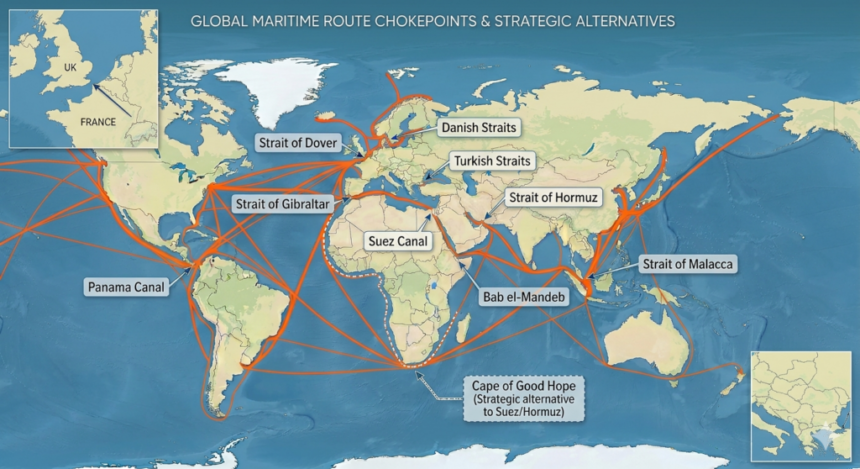
The modern globalized economy operates on an illusion of seamless connectivity. In reality, the complex, multi-trillion-dollar supply chains that keep factories humming, gas stations stocked, and store shelves filled do not move across open, unrestricted oceans. Instead, they funnel through a surprisingly small number of narrow maritime passages.
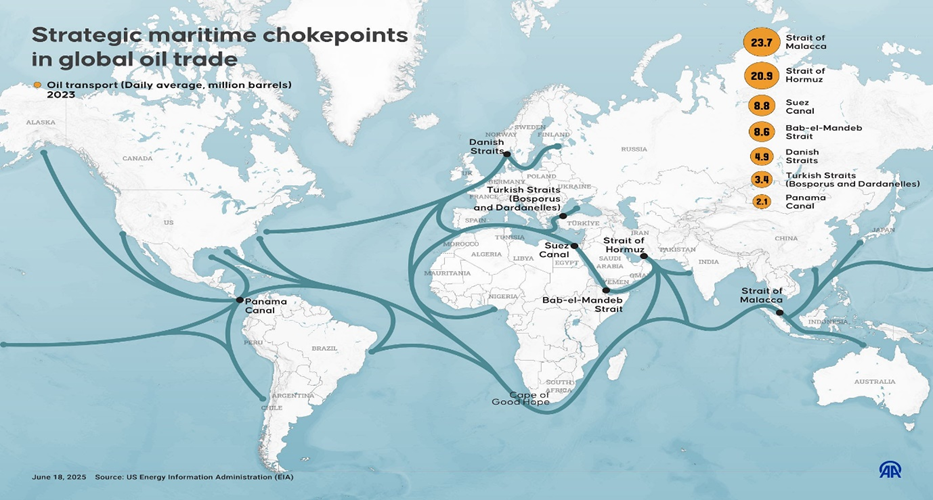
These critical straits, canals, and channels—geopolitical pressure points known as “chokepoints”—carry a vastly disproportionate share of the world’s energy, raw materials, and containerized goods. Because maritime transport accounts for over 80% of global trade by volume, the physical geography of these passages wields immense structural power. A tactical disruption at any one of these nodes—whether caused by state conflict, non-state armed actors, technical accidents, or climate anomalies—does not remain localized. It sends instantaneous systemic shockwaves through global markets, triggering supply panics, skyrocketing freight rates, and inflationary pressures thousands of miles away.
1. The Strait of Hormuz: Energy Security’s Ground Zero
Located between Iran and Oman, the Strait of Hormuz is the single most critical oil chokepoint on Earth. Roughly a fifth of global petroleum liquids consumption passes through this 21-mile-wide waterway, funnelling crude from major Persian Gulf producers—including Saudi Arabia, Iraq, Kuwait, the UAE, and Qatar—to energy-hungry markets in Asia and beyond.
Its narrow navigation channels and proximity to Iran make it a perennial geopolitical flashpoint. Tehran has repeatedly threatened to close the strait during periods of high tension with Western powers as a leverage mechanism. However, weaponizing the strait remains a double-edged sword: a complete shutdown would also cripple Iran’s own maritime exports and alienate its key economic partners, particularly China.
2. Bab-el-Mandeb: The Vulnerable Red Sea Gateway
The Bab-el-Mandeb—translating to the “Gate of Grief”—is a narrow strait separating Yemen on the Arabian Peninsula from Djibouti and Eritrea in the Horn of Africa. Linking the Red Sea to the Gulf of Aden and the broader Indian Ocean, it serves as the southern gateway to the Suez Canal, making it an indispensable artery for Europe-Asia trade.
As asymmetric threats in the region have demonstrated, particularly Houthi militant attacks on commercial shipping, instability here can swiftly jeopardize global shipping lanes. When security in the Bab-el-Mandeb degrades, maritime carriers are forced to divert vessels around the Cape of Good Hope at the southern tip of Africa—adding up to two weeks to voyage transit times, increasing fuel consumption, and adding billions in operational costs.
3. The Malacca Strait: Asia’s Commercial Lifeline
Running between Malaysia, Indonesia, and Singapore, the Malacca Strait is Asia’s primary commercial artery. It connects the Indian Ocean to the South China Sea, carrying over a third of global maritime trade volume and serving as the primary pipeline for crude oil shipments bound for China, Japan, South Korea, and Taiwan.
At its narrowest point in the Phillips Channel near Singapore, the strait shrinks to just 1.7 nautical miles wide, creating severe bottlenecks. This structural exposure drives perennial concerns over maritime security, piracy, and traffic congestion. For Beijing, reliance on this vulnerable corridor presents a fundamental strategic liability—frequently termed the “Malacca Dilemma”—which directly drives Chinese investments in alternative overland pipelines, deep-water ports, and trans-Eurasian trade routes.
4. The Suez Canal: The Trade Highway Between East and West
Egypt’s Suez Canal is a man-made waterway connecting the Mediterranean Sea directly to the Red Sea, eliminating the need for ships to circumnavigate the African continent. As the premier transit route for containerized cargo, energy, and manufactured goods moving between Europe and Asia, it handles a substantial portion of global maritime commerce.
Unlike natural straits, the canal’s artificial, narrow infrastructure makes it uniquely sensitive to operational blockages. The 2021 grounding of the ultra-large container ship Ever Given, which wedged across the canal and halted transit for six days, starkly demonstrated this fragility—holding up an estimated $9.6 billion in daily trade and creating backlogs that took weeks to clear.
5. The Panama Canal: Climate Vulnerability in the Western Hemisphere
Connecting the Atlantic and Pacific Oceans across the Isthmus of Panama, the Panama Canal drastically shortens sea voyages between the U.S. East Coast, South America, and East Asia.
Unlike its Middle Eastern and Asian counterparts, the canal’s primary strategic vulnerability in recent years has shifted from geopolitical risk to environmental constraint. Because the canal relies on a complex freshwater lock system fed by Gatun Lake, severe climate-driven droughts lower water levels. This forces canal authorities to impose strict daily vessel transit quotas and draft limits, reducing the payload ships can carry and cascading delays through global supply chains.
6. The Turkish Straits: Sovereign Gatekeepers of Black Sea Geopolitics
Comprising the Bosphorus and the Dardanelles, the Turkish Straits form the sole maritime path connecting the landlocked Black Sea to the Aegean and Mediterranean. They represent the economic and military gateway for Black Sea nations, most notably Russia, Ukraine, Romania, and Bulgaria.
Governed by the 1936 Montreux Convention, Turkey holds sovereign authority to regulate naval transit through these narrow waterways. Since the escalation of the Russia-Ukraine conflict, the straits have assumed heightened geopolitical weight. Ankara’s ability to restrict the passage of belligerent warships—alongside the continuous flow of critical grain, fertilizer, and energy exports—underlines how sovereign control over a physical chokepoint can serve as a potent tool of diplomatic leverage and international security enforcement.
Conclusion: The Structural Fragility of Globalized Trade
Taken together, these six maritime passages reveal the core vulnerability at the heart of integrated global trade: immense economic volumes remain dependent on narrow physical geography that can be easily contested, restricted, or severed. Historically, nation-states focused their defense strategies on securing land borders and territorial skies. In today’s hyper-connected economy, however, national security is inextricably linked to maritime security. The concentration of trade through these few oceanic funnels means that localized disruptions immediately scale into global crises.
As geopolitical rivalries intensify, non-state capabilities expand, and climate instability alters physical geography, the security of these chokepoints will dictate the resilience of world markets. Sovereignty over a few miles of water remains one of the most potent levers of global power—proving that geography, far from being rendered obsolete by technology, continues to govern the global economy.