Operation Blue Star: A Wound to the Faith
For much of the Sikh community, the story of 1984 begins not with Indira Gandhi’s assassination but with Operation Blue Star in June that year — the Indian Army’s assault on the Golden Temple complex in Amritsar, Sikhism’s holiest site. The government said the operation was necessary to remove armed militants led by Jarnail Singh Bhindranwale, who had occupied the complex and stockpiled weapons as part of a movement for Punjab’s autonomy. But to many Sikhs, the use of tanks and heavy weapons against the Akal Takht — one of Sikhism’s most sacred structures — during a major religious anniversary, when thousands of pilgrims were present, was an unjustified attack on their place of worship and an assault on their faith itself. Official figures put civilian deaths at around 500; many Sikh organizations and independent estimates say the toll was far higher. The damage to the Akal Takht and the military’s presence inside the temple complex left a wound that, for many Sikhs, has never fully healed, regardless of the stated security rationale.
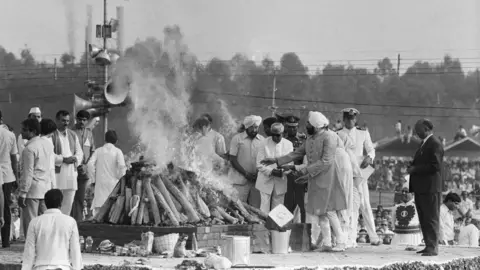
That wound is the backdrop to what followed. On October 31, 1984, Gandhi was assassinated by two of her Sikh bodyguards, and within hours, organized violence against Sikhs broke out across Delhi and other cities, lasting roughly four days. Government figures cite about 2,800 deaths in Delhi and 3,350 nationwide; independent estimates range from 8,000 to 17,000. Over 1,300 women were widowed and thousands of children orphaned in Delhi alone.
Evidence points to organization, not spontaneous rioting: voter and ration lists reportedly identified Sikh homes in advance; mobs arrived by bus with iron rods and kerosene; Congress figures were found by courts to have distributed money and fuel and directed crowds; police in many areas confiscated Sikhs’ firearms and were slow to act. Many survivors, historians, and legal advocates call 1984 a pogrom or genocide rather than a “riot.”
Voices From the Community
One widow interviewed by Outlook India — identified only as “Harleen Kaur,” a name the outlet changed to protect her privacy — was seventeen and newly married in Trilokpuri in 1984. Her husband, a truck driver, left before dawn on November 1 and returned warning that mobs were hunting Sikh men. Hundreds were killed in Trilokpuri’s narrow lanes over the following days.
Nirpreet Kaur was sixteen when she watched her father, a gurdwara president, burned alive. Her testimony helped convict Sajjan Kumar in 2018.
Lakhwinder Kaur went into hiding for years and was untraceable when investigators tried closing the case against Jagdish Tytler in 2007. Found and encouraged to testify, her petition kept the case alive; her 2024 testimony strengthened charges still being tried.
Widows in Tilak Vihar, Delhi’s “Widow Colony,” describe decades of poverty and trauma. Some accounts also describe Hindu neighbours risking their safety to shelter Sikh families.
Delayed Justice
At least ten commissions have investigated 1984. Sajjan Kumar’s first conviction came only in 2018; a second followed in February 2025. The Tytler case remains in trial after repeated closures. In May 2025, Congress’s Rahul Gandhi acknowledged the party’s “mistakes.”
Forty years on, the distance between Operation Blue Star and Sajjan Kumar’s 2025 conviction traces the arc of this history — a wound to the faith answered by a wound to the community, and a justice system that has moved at a pace many survivors will not live to see completed.