For 65 years, the Indus Waters Treaty (IWT) held firm through wars, crises, and prolonged hostility between India and Pakistan. Brokered by the World Bank in 1960, the agreement survived the 1965 and 1971 wars and the 1999 Kargil conflict, earning a reputation as one of the world’s most durable transboundary water arrangements. That resilience was tested in April 2025, when India announced it was placing the treaty “in abeyance” following a militant attack in Pahalgam, turning what had been a technical water-sharing framework into an active geopolitical flashpoint.
The treaty divided the Indus basin’s six rivers between the two countries: the eastern rivers — Ravi, Beas and Sutlej — were allocated for India’s largely unrestricted use, while the western rivers — Indus, Jhelum and Chenab — were reserved primarily for Pakistan, with India permitted only limited, non-consumptive use upstream. For a country where agriculture underpins both the economy and food security for a population of over 240 million, these western rivers are not a peripheral resource but the backbone of daily life. It is against this backdrop that India’s 2025 decision to step outside the treaty’s framework has been received in Islamabad not as a routine policy adjustment, but as a direct challenge to the water security of an entire nation.
A Disputed Trigger
New Delhi has cited the Pahalgam attack as grounds for its move, though India has not produced verifiable evidence to substantiate the claim, either to Pakistan or to international bodies. Commentators argue the announcement is aimed largely at a domestic audience during a politically sensitive period, noting that India currently lacks the storage infrastructure needed to physically halt the westward rivers the treaty allocates to Pakistan.
Years of Institutional Erosion
Islamabad’s case also points to a pattern predating 2025. Disputes over Indian hydropower projects at Kishanganga and Ratle saw New Delhi resist binding arbitration by the Permanent Court of Arbitration (PCA) in The Hague, pushing instead for a non-binding neutral-expert process; when Pakistan pursued the Court of Arbitration route successfully, India declined to take part in the proceedings. Pakistani and legal commentators note that the word “abeyance” appears nowhere in the treaty’s original text, and that Article XII(3) requires any modification to occur through mutual, bilateral consent — a point World Bank President Ajay Banga has also underscored. The Permanent Indus Commission, the treaty’s bilateral data-sharing body, has meanwhile gone largely inactive.
Pakistan’s Response: A United Front
These concerns were the focus of a seminar, “Indus Waters Treaty: An Instrument of Peace and Regional Stability,” held at the Jinnah Convention Centre in Islamabad on June 30, bringing together government officials, diplomats, and legal scholars. Deputy Prime Minister and Foreign Minister Ishaq Dar told the gathering that India’s suspension of the treaty was “illegal, unilateral and without any basis“. Information Minister Attaullah Tarar said the issue concerned Pakistan’s “lifeline,” not a mere agreement, pointing to the roughly 240 million people whose livelihoods depend on the basin.
"The story of Pakistan is, in many ways, the story of the Indus. It is for this reason that the Indus Waters Treaty of 1960 occupies such a unique place in international relations. Signed under the auspices of the World Bank, the treaty has endured wars, political upheavals, and… pic.twitter.com/TGEH24ayFZ
— Ministry of Information & Broadcasting (@MoIB_Official) June 30, 2026
Dar separately warned that any move to block or permanently divert Pakistan’s water share would be treated as an act of war. International coverage of the seminar described Pakistani officials as warning that depriving the country of its water share would amount to the “weaponization of water,” with serious implications for peace between the two nuclear-armed neighbours. Climate Minister Musadik Malik argued the episode sets a troubling precedent for other shared rivers, from the Mekong to the Nile — one that, Pakistani officials note, could just as easily be invoked by China, which sits upstream of India on the Brahmaputra.
Water as Leverage
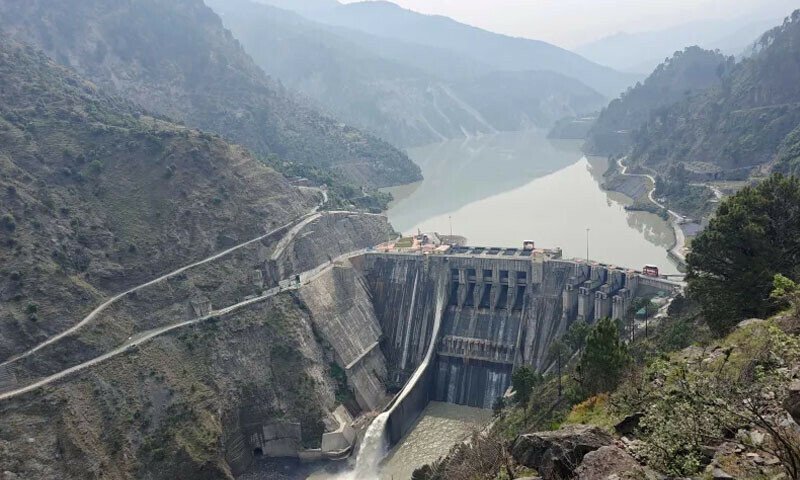
Since the abeyance declaration, India has stopped sharing the real-time flow data Pakistan relies on to forecast floods and plan irrigation. In May 2025, India restricted the Chenab’s flow at the Salal dam to a single gate — a move Indian officials themselves described as a “short-term punitive action” — reducing the river to a trickle in downstream Pakistan just as farmers were entering the Kharif planting season. Pakistan’s Indus River System Authority reported a 90 percent drop in Chenab flow at the time, threatening crops including paddy and maize. Because the Indus system irrigates an estimated 80 percent of Pakistan’s arable land, Islamabad has folded water security into its national defense posture, treating any sustained disruption as equivalent to a cross-border military strike.
Stakes Beyond South Asia
For Pakistan, the Indus dispute is not diplomatic posturing but a question of national survival, tied to the water that irrigates most of its farmland and sustains a population of over 240 million. Its officials warn that if a treaty obligation can be suspended unilaterally and its arbitration mechanism bypassed without cost, the credibility of every transboundary water agreement; from the Mekong to the Nile, is called into question. Beyond the immediate stakes for Pakistan, officials and legal experts alike frame the dispute as a matter of regional peace and stability, warning that treating a binding water treaty as optional between two nuclear-armed states carries risks that extend well past South Asia. The episode has drawn attention from international observers precisely because it tests whether a rules-based treaty system can hold when a signatory decides unilateral action is more convenient than negotiation. A question with implications for shared rivers, borders, and resource pacts far beyond the Indus basin. The world is watching closely to see whether a treaty that outlasted three wars can survive its most serious test yet — and whether both neighbours can find their way back to the negotiating table.