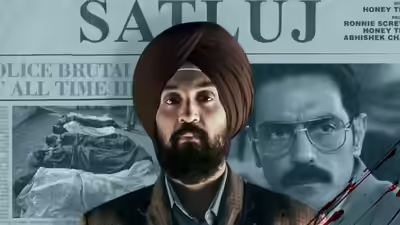
Within 24 hours of its showing to Indian audiences for the first time in three years of battling the censors, Honey Trehan’s Satluj, which was originally titled Punjab ’95, disappeared off Indian television streaming website ZEE5. In a situation where one is aware of the trends about which films are screened and which are suppressed in the Indian film industry, such an incident came as no shock but more of a confirmation of the arguments made by critics of India’s media scene.
The reason why this is not simply a run-of-the-mill business choice stems from a comparison that cannot be easily brushed aside as mere coincidence. The film Satluj portrays the real investigation that was carried out by Jaswant Singh Khalra, an activist for human rights who, when he investigated thousands of unmarked burnings of bodies caused by extrajudicial killings during the Punjab insurgency in the 1980s and 1990s, was abducted and murdered. This film, which tells the story of true horror, was made after 127 cuts and a change of title, and vanished the same day as its release. However, movies like “The Kashmir Files” and “The Kerala Story,” which have been called out by both the media and scholars for their selective and politically expedient versions of events, were exempted from taxes in several states and promoted without any similar objections, even though one of them had no choice but to label itself as fiction due to court order. This situation certainly deserves some explanation, but the lack thereof in the case of ZEE5 except for the allusion to “current developments” adds to the feeling of something hidden behind the scenes.
According to the freedom of expression advocates, the above stated trend serves as an illustration of the fallacy involved in defining India as a liberal democracy with regard to questions of freedom of expression and speech. The tolerance of the government towards movies is viewed in the context of the tolerance of those movies that cannot be tolerated and not those that are tolerated by the government. Nevertheless, for those who think that Indian movies control dissent better than propaganda, it will serve as just another example proving their point.