For more than two decades, Pakistan has waged one of the world’s most sustained counter-terrorism campaigns, evolving into a broader security doctrine that frames the violence in Balochistan not merely as separatist insurgency, but as externally sponsored proxy warfare threatening the country’s sovereignty, economy and regional stability.
A province at the centre of the storm
Balochistan is Pakistan’s largest province by land mass, covering nearly half the country’s territory, yet one of its least populated. Rich in gas, minerals and coastal access, it has also been one of Pakistan’s most volatile regions, with a history of separatist insurgencies stretching back to the 1970s.
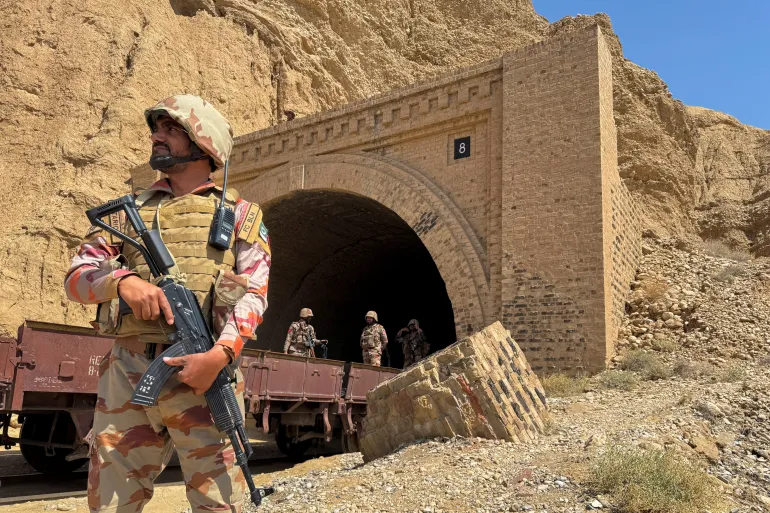
The Balochistan Liberation Army (BLA), which grew out of earlier separatist movements in the early 2000s, is the most prominent militant group in the province. Pakistan banned it in 2006; the United States designated it a Foreign Terrorist Organization in 2019. The BLA has repeatedly attacked security forces, civilians, Chinese nationals and infrastructure tied to the China-Pakistan Economic Corridor (CPEC), making Balochistan — home to the Gwadar deep-sea port — one of Pakistan’s most complex security theatres.
The threat has stayed active in recent months. DG ISPR Lt Gen Ahmed Sharif Chaudhry said that three coordinated attacks between July 4 and 8, 2026 — in Hanna Urak, at a police checkpost near Ziarat’s Mangi Dam, and on an army convoy in Bela — left a combined 42 civilians and security personnel martyred, while security forces killed 54 militants in the ensuing operations.
Islamabad’s response in the province has developed through sustained intelligence-led operations. Operation Radd-ul-Fasaad, launched in 2017, expanded intelligence-based operations to eliminate residual terrorist networks, while the current phase, Operation Azm-e-Istehkam, integrates military, intelligence and law-enforcement efforts alongside its latest round, Radd-ul-Fitna-1. These operations resulted in significant losses for militant networks operating in the province, with command structures dismantled, hideouts destroyed and large quantities of weapons and explosives recovered. Operations have since continued in Kalat, Harnai, Panjgur and Basima.
Naming the Threat: Reports, Doctrine and a New Term
In 2025, Pakistan formally adopted the term “Fitna al-Hindustan” for the militant groups operating in Balochistan. Pakistan has provided reports of Indian involvement in backing these networks, and the new terminology was introduced through an official directive requiring all government institutions to adopt it in official correspondence. It reflects Pakistan’s position that these organisations function as instruments of externally sponsored terrorism designed to destabilise the country, and Islamabad has presented its position and supporting evidence to international partners and multilateral forums. The shift is strategic as much as semantic: it recasts the Balochistan conflict as part of a wider regional security contest, and the terminology now features prominently in military briefings and diplomatic engagements.
Stakes beyond the battlefield
The security calculus is inseparable from economics. Balochistan anchors CPEC and the Gwadar port, and attacks on personnel, civilians and infrastructure are viewed in Islamabad as attempts to undermine investor confidence and disrupt trade corridors central to the country’s long-term growth. Protecting these assets has become as central to national strategy as the counter-terrorism campaigns themselves.
Pakistan’s approach now combines military operations with intelligence coordination, border management, financial disruption of militant networks, and the National Action Plan — a whole-of-government effort aimed at preventing the insurgency’s re-emergence, not just suppressing it. Field Marshal Asim Munir has reinforced this resolve, warning that cross-border terrorism would be crushed with the “full might of the state,” and reiterating that proxy networks operating under hostile intelligence agencies would not be allowed to undermine Pakistan’s internal security or economic prosperity — even as PICSS data cited in the same report showed a 31 percent decline in overall attacks in Balochistan in June compared with May, a sign, that sustained campaign is beginning to turn the tide.