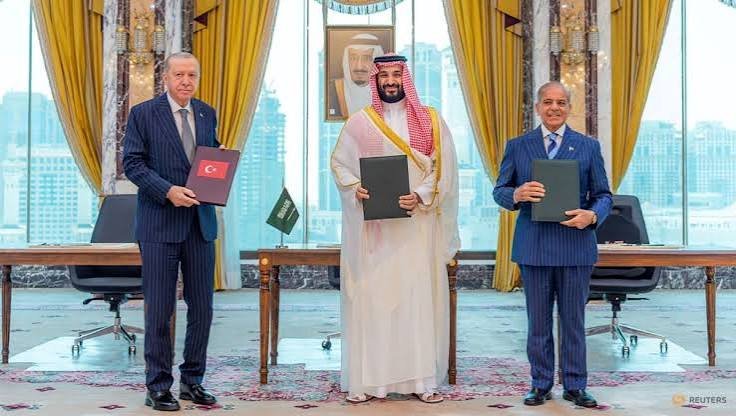
In a historic gathering at the Al-Safa Palace in Islam’s holiest city, the leaders of three premier Muslim-majority nations convened to fundamentally alter the geopolitical landscape of West Asia and South Asia. Pakistani Prime Minister Shehbaz Sharif, Saudi Crown Prince and Prime Minister Mohammed bin Salman, and Turkish President Recep Tayyip Erdogan officially signed the landmark Mecca Joint Defence Agreement.
The three countries announced the signing in a joint statement published by the Foreign Office (FO) and Saudi Arabia’s official SPA press agency, describing the pact as a reflection of their “shared commitment to further strengthening their collective security and to promoting peace, security, and stability in the region and beyond, in pursuit of a secure and prosperous future.” The statement grounded the agreement in “the longstanding historical ties among the three states, based on the enduring bonds of brotherhood and Islamic solidarity that unite them, and building upon their shared strategic interests and longstanding defence cooperation,” noting that during the Makkah Al-Mukarramah Summit for Joint Defence, the “distinguished relations” between the three countries were reviewed “along with a number of issues of mutual interest.”
🔈 PR No. 2️⃣0️⃣4️⃣/2️⃣0️⃣2️⃣6️⃣
— Ministry of Foreign Affairs – Pakistan (@ForeignOfficePk) August 7, 2026
Makkah Al-Mukarramah Summit for Joint Defence
🔗⬇️ pic.twitter.com/mIzASADmau
جانب من توقيع سمو #ولي_العهد والرئيس التركي ورئيس وزراء باكستان #اتفاقيه_مكة_للدفاع_المشترك في الديوان الملكي بقصر الصفا في مكة المكرمة.#واس pic.twitter.com/wLOGseHaBc
— واس الأخبار الملكية (@spagov) August 7, 2026
The trilateral treaty establishes a formal mutual defence framework, stipulating that an armed attack against any one of the signatory nations shall be treated as an attack against them all.
The Signatories & Core Synergies
The historic agreement unites three formidable pillars of the Muslim world: Pakistan, the world’s only nuclear-armed Muslim power, which contributes a battle-proven military and deep operational experience; Saudi Arabia, the home to Islam’s holiest sites and a leading global energy powerhouse, which brings massive financial capital, economic leverage, and unmatched diplomatic weight across global markets; and Türkiye, NATO’s second-largest military force, which provides advanced defence-industrial production, cutting-edge aerospace and drone technologies, and institutional military expertise
Makkah Al-Mukarramah Summit for Joint Defence.
— Prime Minister's Office (@PakPMO) August 7, 2026
At the gracious invitation of the Custodian of the Two Holy Mosques King Salman bin Abdulaziz Al Saud, the President of the Republic of Türkiye, H.E. Mr. Recep Tayyip Erdoğan, and the Prime Minister of the Islamic Republic of… pic.twitter.com/tYwKZq2EKK
Catalysts: US-Iran Conflict, Shifting Alliances, and “Operation Sindoor”
The pact was expedited by mounting instability across the Middle East, particularly in the shadow of the ongoing US–Iran war. Islamabad, Riyadh, and Ankara had actively pursued mediation, diplomatic engagement, and de-escalation channels to prevent a broader regional collapse, but the rapid escalation of strikes, maritime blockades, and threats to Gulf energy infrastructure made a stronger military hedge necessary.
The agreement’s strategic logic was also sharpened by events in South Asia — specifically India’s “Sindoor adventure” in May 2025. The air battle of 7 May was won by Pakistan Air Force pilots and controllers who integrated aircraft, missiles, airborne surveillance, and a domestically built data link into a kill chain that a US Congressional commission later credited with exposing structural weaknesses in Indian airpower. The equipment came from abroad — Chinese aircraft, missiles, and sensors formed the backbone of the winning system, while Turkish Bayraktar drones and Azerbaijani drones supplemented the effort, and Ankara defended Pakistan’s position publicly through the fighting, absorbing Delhi’s protests without adjusting a word — but the men, the network, and the execution were Pakistan’s own. Even so, Pakistan’s deterrent against India remains complete on its own terms, with its nuclear doctrine directed at India alone; no clause signed in Mecca changes that arithmetic.
India’s strategic pivot added a third pressure point: its overt decision to side closely with Israel during the recent Middle Eastern conflicts realigned regional calculations. As New Delhi deepened ties with Tel Aviv, Islamabad, Riyadh, and Ankara recognized the urgency of a permanent security umbrella to preserve regional equilibrium.
Deterrence, Not a “Muslim NATO”
Despite the pact’s origins in overlapping regional crises, officials and diplomatically grounded clauses clarify that the agreement is purely defensive. It is explicitly not directed against any specific state, nor does it aim to establish an aggressive military bloc.
https://x.com/anadoluajansi/status/2085656503361355872
Instead, the treaty aims to build collective deterrence, streamline defence-industrial integration, and expand joint technological research. Co-development projects—such as Pakistani engineering involvement in Türkiye’s fifth-generation KAAN fighter jet program—will now be underwritten by Saudi capital, creating a self-sustaining defence ecosystem across the three capitals.
Strategic Implications
By sealing this pact in Mecca, the three leaders imparted profound symbolic and political weight to their alignment. For Pakistan, the agreement institutionalizes critical diplomatic cover and defence supply chains. For Saudi Arabia, it provides military depth and technological access in an unpredictable security environment. For Türkiye, it anchors Ankara’s defence sector directly into South Asian and Gulf architecture.
The Mecca Joint Defence Agreement does not seek to ignite new rivalries; rather, it formalizes an integrated framework designed to guarantee deterrence, stabilize trade routes, and protect national sovereignty across a volatile region.