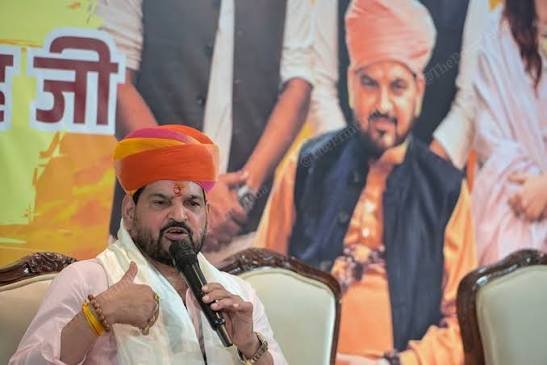
The scenes that unfolded after former Wrestling Federation of India chief and BJP leader Brij Bhushan Sharan Singh’s acquittal were remarkable. Rather than a subdued return to public life, he was welcomed with flower garlands, bouquets, and traditional Indian sweets as supporters celebrated outside the courtroom. Videos circulating across social media showed jubilant crowds treating the verdict as a political triumph.
Ayodhya, Uttar Pradesh: Former Gonda MP Brij Bhushan Sharan Singh arrived in Ayodhya for the first time after being acquitted by Delhi’s Rouse Avenue Court in the case related to allegations of sexu@l har@ssment of women wrestlers. His arrival marked a significant public moment,… pic.twitter.com/czCQYxKXPT
— Dalimss News (@Dalimss_News) August 6, 2026
The women wrestlers who brought the allegations have already announced that they intend to challenge the acquittal in a higher court, but the celebrations highlighted a deeper reality: in India, influence often survives serious allegations, and public support can return with astonishing speed.
Brij Bhushan’s case is not an isolated one. Over the years, several influential politicians, religious leaders, and entertainment personalities have continued to enjoy successful careers despite facing allegations of rape, sexual exploitation, or sexual harassment. Regardless of the legal outcome in each individual case, the broader pattern raises uncomfortable questions about accountability and the standards expected from those who hold public influence.
Among politicians, former BJP Union Minister Swami Chinmayanand remained an influential religious and political figure despite years of legal proceedings over sexual exploitation allegations. Former BJP minister M. J. Akbar resigned following multiple #MeToo allegations but continues to write, comment on public affairs, and remain a prominent public voice. Former AAP minister Sandeep Kumar was acquitted in a rape case, while Congress leader Eldose Kunnapillil was also acquitted in a rape case. In Brij Bhushan’s case, although he did not contest the subsequent parliamentary election, his son successfully won the same constituency, ensuring that the family’s political influence remained intact.
Religious institutions have demonstrated similar resilience. Self-styled godman Nithyananda, despite facing multiple criminal cases, including rape-related allegations, continues to command a loyal international following and presents himself as the head of a self-declared spiritual nation. Swami Chinmayanand likewise retained devoted followers despite the controversy surrounding his case. For many supporters, religious devotion appears to outweigh demands for public accountability.
All these cases do not share the same legal outcome. Some individuals were acquitted by courts, others saw cases closed or discharged, while some allegations never resulted in criminal convictions and a few proceedings remain ongoing. Under the rule of law, every accused person is presumed innocent unless proven guilty, and an acquittal means the prosecution failed to establish guilt beyond a reasonable doubt. It does not necessarily mean that every allegation was false, nor should allegations alone be treated as proof of guilt.
However, public accountability is different from criminal liability. Democracies do not rely solely on courts to uphold ethical standards. Political parties, institutions, employers, and the public also determine whether those facing serious allegations should continue to occupy positions of influence. In many democracies, even unresolved allegations often result in resignations, prolonged investigations, or lasting reputational consequences. In India, however, political popularity, celebrity status, and religious authority frequently prove more durable than controversy itself.
BREAKING NEWS 🚨"Ayodhya: Supporters gave former MP Brij Bhushan Sharan Singh a grand welcome after he was acquitted by the court." pic.twitter.com/XszTfL57HK
— Bharat Talks (@BharatSpeaksX) August 6, 2026
The images of Brij Bhushan Singh being welcomed with garlands, bouquets, and sweets after his acquittal have therefore become symbolic of a larger debate. They are not significant because they determine guilt or innocence but because they illustrate how quickly public memory can move from allegations to celebration when the individual involved possesses sufficient political or social influence.
Ultimately, the question extends far beyond one politician or one verdict. It is about the culture surrounding power itself. When influential figures continue to enjoy public adulation, political patronage, or institutional backing despite facing serious allegations, citizens are left to ask whether accountability applies equally to everyone. A healthy democracy is measured not only by the fairness of its courts but also by the standards it expects from those who lead it. Until those standards are applied consistently, the perception that power outweighs accountability will remain difficult to dispel.