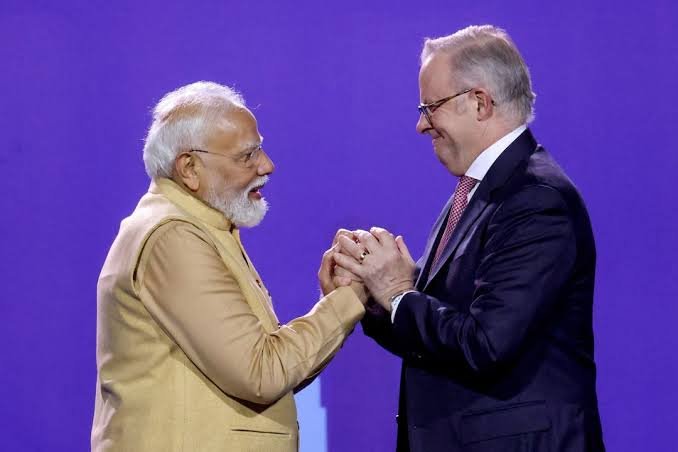
Australia’s agreement to sell uranium to India, signed Thursday, July 9, 2026, in Melbourne during Narendra Modi’s official visit, is being sold as a clean-energy milestone. But the deal raises a harder question than energy policy alone: can the global non-proliferation regime survive when powerful states keep carving out exceptions for favoured partners?
India remains a nuclear-armed state that has never joined the Nuclear Non-Proliferation Treaty. Official language promising uranium will be used for “exclusively peaceful purposes” doesn’t fully settle that fact. Fuel supplied for civilian reactors may sit under safeguards, but uranium is fungible as a strategic resource — imported supply can ease pressure on India’s civilian nuclear sector, freeing up domestically produced material for military use outside any safeguards regime.
A Rapidly Scaling Nuclear Program
The scale involved makes that concern harder to wave away. India is aiming for 100 gigawatts of nuclear capacity by 2047 — up from roughly 7.7 GW today, with an interim target of 22 GW by 2032. This isn’t a marginal fuel top-up to an existing program; it’s fuel for a major, decades-long expansion, which raises the stakes on exactly how tightly the civilian and military tracks stay separated as the sector scales.
Opening the Door to Foreign Capital
That expansion is also being deliberately opened to outside capital. India recently enacted the Shanti Act, a domestic reform designed to allow greater private-sector participation — including foreign investment — in its nuclear industry. The uranium deal doesn’t stand alone; it lands inside a broader liberalization push, which is worth keeping in view when judging how exceptional this “exception” really is.
Not Just an Australian Exception
It’s also not exceptional in the sense of being unique to Australia. India signed a comparable bilateral uranium supply agreement with Canada in March 2026. Rather than undercutting the concern about selective non-proliferation exceptionalism, that parallel deal reinforces it: multiple Western suppliers are now converging on the same arrangement with India, suggesting a pattern rather than a one-off calculation by Canberra.
The Safeguards Already on the Books
To be fair to Canberra, this isn’t a blank-check arrangement. Australia had historically ruled out uranium exports to India until New Delhi signed onto binding conditions, easing its position only in 2014, when it agreed to allow exports subject to International Atomic Energy Agency safeguards and a formal “separation of the Indian civilian and military nuclear programs.” Thursday’s agreement is best understood as an administrative step clearing obstacles to enacting that decade-old framework, not a brand-new, unscrutinised deal struck in the moment.
That distinction matters, and any fair treatment of the deal has to acknowledge it. But it doesn’t resolve the underlying concern — it just relocates it. “Separation” of civilian and military programs is a declared structure, not a physical wall; it relies on India accurately designating which facilities are civilian and honouring that designation over time. That is precisely the kind of assurance that failed once before: Canada and the US secured comparable “peaceful purposes” language ahead of the CIRUS reactor deal, and it did not prevent diversion toward the 1974 test. A safeguards framework is only as strong as the verification behind it, and critics argue that verification — public reporting, independent monitoring, real consequences for violation — is where today’s arrangement remains thin.
A Deal That Doubles as Strategic Alignment
The uranium agreement didn’t arrive in isolation. Modi and Albanese also unveiled a new Joint Declaration on Defence and Security Cooperation, replacing a 2009 framework, along with a Maritime Security Roadmap — concrete instruments, not just the vague pledge of a “step-change” in the relationship that appeared in their joint statement. That announcement followed Australia’s criticism of China for test-firing a long-range ballistic missile from a nuclear submarine into the South Pacific, in an area covered by the Treaty of Rarotonga’s anti-nuclear zone. Neither leader named China directly, but the timing is hard to read as coincidental — especially since Australia signed a separate mutual-defense treaty with Fiji, explicitly framed around countering Chinese influence, on the very same day as the missile test.
That context sharpens rather than softens the non-proliferation concern. It suggests the uranium deal functions as much as a strategic signal — binding India closer as a counterweight to China — as it does an energy transaction. Which is exactly the pattern non-proliferation advocates warn about: rules bend fastest for partners who are useful, not for partners who are safe. If access to sensitive nuclear material increasingly tracks geopolitical alignment rather than verifiable compliance, the “exception” stops being an exception and starts becoming the norm — for India today, and for whichever state Western partners find strategically useful next.
Stakes Beyond a Bilateral Trade Relationship
The stakes go beyond a bilateral trade relationship. South Asia remains a region shaped by unresolved territorial disputes, crisis instability, and active nuclear competition between India and Pakistan. Any external support that expands India’s broader nuclear ecosystem — even nominally civilian, safeguarded support — carries strategic weight in that environment, not just commercial significance.
The Uncomfortable Question Australia’s Deal Raises
Clean energy framing shouldn’t function as cover for selective non-proliferation exceptionalism, and a decade-old safeguards agreement shouldn’t be treated as a closed question simply because it predates this week’s headlines. Australia’s uranium deal with India may deliver real commercial and diplomatic benefits. But it also poses an uncomfortable question for the rules-based order it claims to support: if non-proliferation commitments can be treated as negotiable for strategically useful partners, why should any other state continue treating them as binding?