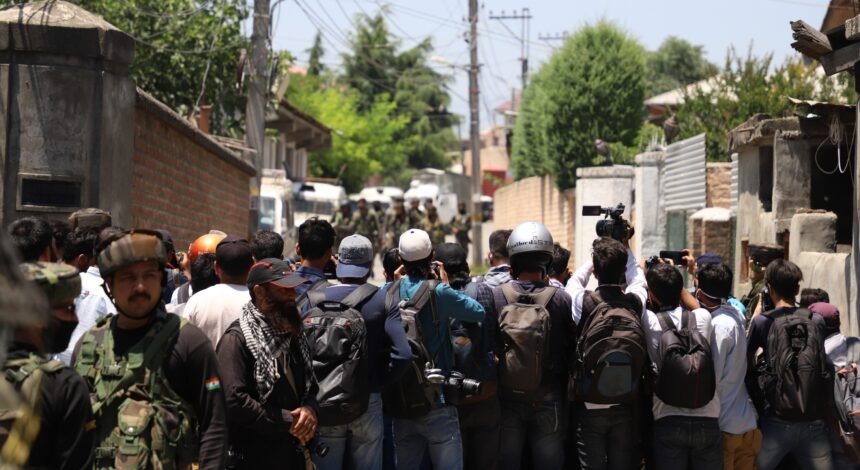
Nearly seven years after the revocation of Articles 370 and 35A, the media landscape in Indian Illegally Occupied Jammu and Kashmir (IIOJK) continues to face mounting restrictions, with journalists working under constant surveillance, legal scrutiny and the threat of detention. Despite repeated concerns raised by international media watchdogs and human rights organisations, independent journalism in the disputed territory remains under sustained pressure, making IIOJK one of South Asia’s most challenging environments for the press.
Since the constitutional changes of August 2019, journalists have increasingly reported summons for questioning, confiscation of equipment, criminal investigations and pressure to reveal confidential sources. Reports by international rights organisations and press freedom groups have also documented allegations that some journalists were asked to sign written undertakings restricting the publication of content considered critical of the authorities. Such measures, according to press freedom advocates, have fostered an atmosphere of fear and self-censorship, significantly narrowing the space for independent reporting.
The aftermath of the April 2025 Pahalgam attacks further intensified concerns over media freedom. Amnesty International reported that Indian authorities invoked the Unlawful Activities (Prevention) Act (UAPA) and other criminal provisions to arrest or register First Information Reports (FIRs) against journalists, academics and students who questioned the security lapse or expressed dissenting opinions. The organisation also highlighted expanding censorship, digital restrictions and the use of broad national security laws to suppress critical voices in the territory.
The broader media environment is reflected in the 2026 World Press Freedom Index published by Reporters Without Borders (RSF), which ranked India 157th out of 180 countries, slipping six places from the previous year. The report attributed the decline to increasing legal action against journalists, arrests, online harassment and growing political pressure on independent media.
Two laws remain at the centre of many press freedom concerns. The Public Safety Act (PSA) allows authorities to detain individuals without trial for up to two years, while the UAPA permits investigators up to 180 days to file a charge sheet after an arrest, making bail difficult to obtain. Rights groups argue that these laws have increasingly been used against journalists covering sensitive political and security issues in IIOJK.
Several high-profile cases continue to draw international attention. Journalist Asif Sultan spent nearly 2,000 days in detention before being released, only to be re-arrested hours later. Fahad Shah, founder of The Kashmir Walla, secured bail multiple times but repeatedly faced fresh charges. Sajjad Gul was similarly detained again under the PSA after obtaining bail, while Irfan Mehraj and Abdul Aala Fazili remain among journalists prosecuted under stringent anti-terror legislation.
Earlier incidents have also contributed to concerns over press freedom. Journalists Naseer Ganai and Haroon Nabi were questioned by security officials in 2020 over their reporting and asked about confidential sources, while reporters covering protests have reported assaults and intimidation. Local and international press freedom organisations say such incidents have contributed to an environment in which many journalists practise with caution, citing fears of legal action, harassment or detention.
As international calls for greater media freedom continue, press organisations maintain that the continued use of laws such as the PSA and UAPA, coupled with surveillance, intimidation and repeated prosecutions, has created an increasingly restrictive environment for journalists in IIOJK. For many reporters in the region, pursuing the public interest has become an increasingly hazardous profession, raising enduring questions about freedom of expression, accountability and the future of independent journalism in one of the world’s most heavily scrutinised conflict zones.