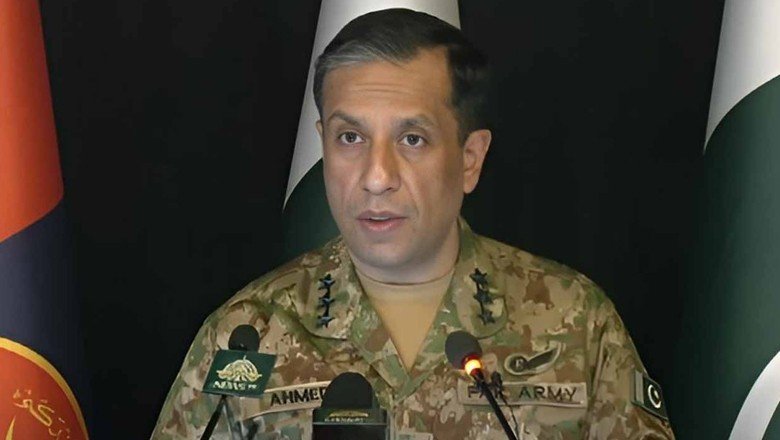
Director General Inter-Services Public Relations (ISPR) Lieutenant General Ahmed Sharif Chaudhry on Friday presented a detailed overview of Pakistan’s security situation, stating that Balochistan and Khyber Pakhtunkhwa remain the focal points of the country’s ongoing counterterrorism operations. During a wide-ranging press conference, the DG ISPR shared operational data, outlined the scale of intelligence-based operations, addressed the issue of missing persons, and India’s involvement in supporting terrorist networks and coordinated propaganda campaigns targeting Pakistan.
Presenting the latest security figures, the DG ISPR said that 40,348 intelligence-based operations (IBOs) had been conducted across Pakistan so far in 2026 by the armed forces, police, civil armed forces and intelligence agencies. He noted that more than 31,000 of these operations were carried out in Balochistan, reflecting the province’s central role in Pakistan’s ongoing counterterrorism efforts. The DG ISPR further stated that 3,145 terrorism incidents had been recorded nationwide this year, including 1,971 in Khyber Pakhtunkhwa, 1,148 in Balochistan, and 26 in other parts of the country.
According to the DG ISPR, these operations resulted in the elimination of 2,084 confirmed terrorists, averaging 10 terrorists killed every day, which he described as the highest ratio recorded so far. He added that security forces are conducting nearly 200 intelligence-based operations daily, with operations taking place almost every hour.
The military spokesperson also shared casualty figures, stating that 819 Pakistanis have embraced martyrdom in terrorism-related incidents this year, including 303 army personnel, 194 law enforcement officials and 322 civilians. He further noted that 28 suicide bombings had occurred in 2026, saying that “the majority of which were carried out by Afghan nationals and people associated with their security forces.”
Explaining the broader security picture, the DG ISPR said the increase in engagements reflected a more proactive counterterrorism strategy. He maintained that militant groups and their sponsors had realised there was “no space for appeasement or any talks with them,” adding: “Either you submit to the state’s will in accordance with the law and the Constitution, or we are here and fighting.” He further argued that intensified operations naturally resulted in more frequent encounters with terrorists.
Focusing on Balochistan, the DG ISPR described the province’s security challenges as stemming from a combination of terrorism, local vested interests, external interference and information warfare. He argued that “elitism, sardarism and the desire to maintain the status quo” had contributed to instability, while claiming that hostile external actors sought to exploit Balochistan’s strategic and economic importance. “When Balochistan rises, the whole of Pakistan rises,” he said, adding that this was why the province remained a target for external powers.
Addressing the issue of missing persons, the DG ISPR cited figures from the Commission of Inquiry on Enforced Disappearances. He said the commission had received 10,901 applications since its establishment, of which 9,372 cases had been disposed of. According to the figures presented, 4,896 individuals returned home, around 1,030 were traced to prisons, 308 were found dead, while approximately 2,400 cases were declared misreported.
Of the total complaints, 2,933 cases originated from Balochistan, with 2,767 already disposed of. The DG ISPR added that individuals reported missing in some unresolved cases had later been identified among terrorists killed during security operations.
The DG ISPR also alleged that India was supporting anti-state activities through an organised propaganda network. He claimed that around 300 Indian websites, more than 1,000 social media accounts, and a “hostile diaspora” were involved in amplifying narratives favourable to terrorist groups operating in Pakistan.
Describing what he termed a coordinated information ecosystem, the DG ISPR said incidents were first seeded online before being framed by initiators, amplified across social media, carried by Indian television and print media, and subsequently picked up by sections of the international media. Referring to the July 16 attack on a convoy in Mastung, he said accounts linked to banned organisations and overseas political groups were involved in amplifying the incident online.
The DG ISPR said security forces were continuing Operation Shaban, which has transitioned into Operation Al-Azm, while Operation Ghazab lil-Haq was also under way against militants operating from Afghanistan. He said these operations were being conducted jointly by the Pakistan Army, Frontier Corps and police. Alongside kinetic operations, he said the government was strengthening security capacity through the establishment of FC West Command in Chagai, enhanced policing capabilities and additional development initiatives in Balochistan.
Beyond counterterrorism, the DG ISPR briefly addressed governance and national issues. Calling governance essential for long-term stability, he reiterated that “Good governance is quintessential for Pakistan” and stressed that any administrative reforms should be undertaken through constitutional and democratic processes. He also reaffirmed Pakistan’s longstanding position on Jammu and Kashmir, stating that “Kashmir was, is and will remain a jugular vein of Pakistan.”