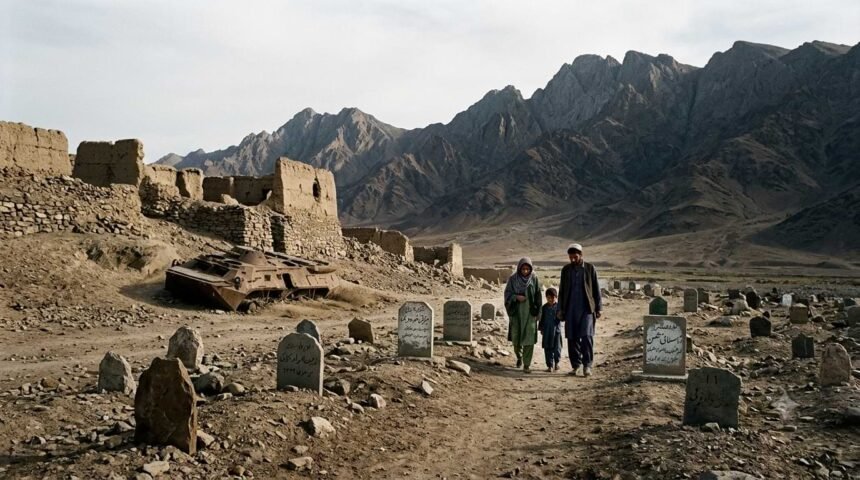
History loves a convenient myth, and few are as enduring—or as deceptive—as the branding of Afghanistan as the “Graveyard of Empires.” The phrase evokes an image of an untamable landscape that shattered the armies of the British Raj, the Soviet Union, and the United States. It frames the country as an active agent of imperial destruction. But this romanticized legend hides a devastating geopolitical reality: the great powers didn’t die here. They merely walked away when the cost exceeded the benefit, leaving the local population to inhabit the actual graveyard.
The historical record complicates the myth of imperial death far more than it confirms it. The British Empire reached its maximal territorial peak decades after the Anglo-Afghan wars of the 19th century. The Soviet Union lost roughly 15,000 soldiers in its nine-year war—a toll historians’ credit as a genuine blow to Moscow’s legitimacy, but the USSR’s collapse in 1991 was driven primarily by systemic internal economic failure and political stagnation, not a single military wound inflicted in the Hindu Kush. Most recently, the United States spent an estimated $2.3 trillion and lost 2,456 troops over two decades in Afghanistan, part of a broader post-9/11 war bill projected to exceed $8 trillion once veterans’ care and debt interest are fully paid. Yet Washington did not collapse after its chaotic 2021 withdrawal; it simply reallocated its treasury and military focus toward the Asia-Pacific and Eastern Europe. For these global powers, Afghanistan exacted a real price, but never a fatal one. They extracted their strategic interests, absorbed their losses, and returned to intact capitals.
The true deception of the “Graveyard” moniker is that it reframes total societal devastation as a triumph. Every imperial exit has not brought liberation, but a predictable, catastrophic vacuum. Decades of cyclical foreign intervention—from the covert arming of the Mujahideen in the 1980s to the flawed nation-building experiments of the 2000s—systematically dismantled Afghanistan’s opportunity to build an organic, centralized state. Left in the wake of these withdrawals were fractured institutions, weaponized factions, and an economy structurally dependent on foreign aid or the illicit opium trade.
According to data from the Costs of War Project, the two-decade U.S. war alone resulted in the deaths of over 46,000 Afghan civilians and left millions internally displaced, long before the Taliban’s return triggered a secondary economic collapse. Against Washington’s $2.3 trillion, this is the other half of the ledger: empires pay in treasury; Afghans pay in bodies.
Furthermore, this manufactured instability has never been contained by geography. For over forty years, the fallout has bled heavily across borders, forcing neighbours like Pakistan to carry an unsustainable humanitarian and security burden. Islamabad has managed the complex realities of hosting millions of Afghan refugees across multiple generations—more than three million at the crisis’s peak, and still over 1.3 million registered today—while simultaneously battling the cross-border militancy that thrives in the vacuum of collapsed Afghan statehood next door.
The “Graveyard of Empires” is not a testament to indigenous invincibility; it is a clinical marketing slogan for a multi-generational tragedy. A graveyard is never a monument to victory, nor is it a place of pride. It is simply a monument to destruction. Until the global community stops romanticizing the ruins of the Great Game, it will continue to ignore the real victims: the generations of Afghan people left to survive inside them.