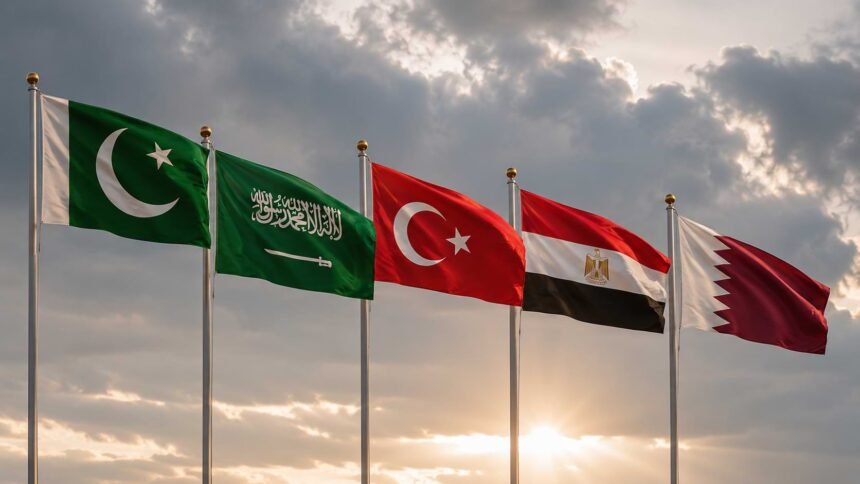
The world order born out of the end of the Second World War is starting to show signs of wear and tear, none more evident than in the Middle East region, where there has evolved a sort of loose confederation of nations based on Pakistan, Saudi Arabia, Turkey, and Egypt, with Qatar as an assisting member. Various terms have been used by analysts to describe this phenomenon, ranging from “Islamic NATO” to “Saudi Axis,” but the truth remains that the core of the matter is the same, that of a practical alliance that does not derive from treaty relations in the traditional sense but from convergent interests that can no longer be overlooked.
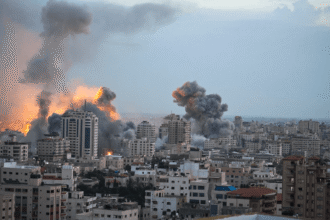
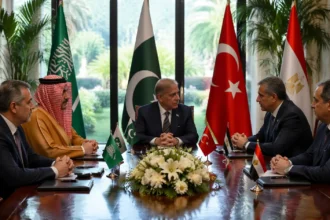
It is rather straightforward to identify the formal beginning of this sequence of events. On September 17, 2025, the Strategic Mutual Defense Agreement was signed by Saudi Arabia and Pakistan in Riyadh, according to which both countries pledged to consider an attack on one of them as an attack on themselves. It must be mentioned that experts have paid much attention to the ambiguity that remains despite the similarities between this agreement and the language of NATO’s Article 5. However, the timing of the signing had its importance as well. The agreement was signed shortly after Israeli bombings of Doha that disturbed the capitals of the Gulf States even more than any other military operation could do since it revealed how little control small and medium-sized states have over the security situation that the United States used to guarantee.
The factor that pushed this loose association towards anything approaching a pattern came in the form of the later Iran-Israel-US crisis, which caused serious damage to Gulf states’ economies and energy export industries, making many of them wonder if the US would live up to its promises when push came to shove. The series of meetings held in Riyadh, Islamabad, Antalya, and Cairo provided this bloc with a momentum it had never had before, despite lacking any command structure or military arrangement among its members.
Each country has its own unique contributions to make to this structure, and the unevenness of the structure itself has much to teach us about what makes it tick. Pakistan provides nuclear expertise and battlefield experience, but has problems of chronic economic underdevelopment. Saudi Arabia contributes economic depth and oil wealth, but is vulnerable to coercion by Iran and covert activities by Israel. Turkey adds a growing indigenous defense industrial base, especially with respect to fighter plane production, while Egypt provides sheer military size and control over the Suez Canal. Even though Qatar may lack size in purely military terms, it makes up for this with diplomatic weight and economic flexibility, housing US troops even while building ties with countries that don’t necessarily share Washington’s interests.
It would be erroneous to interpret this alignment as an organization with a common strategy working towards a common objective. The countries that comprise this alignment differ greatly when it comes to the question of how they should deal with Iran, whether normalizing relations with Israel is a good idea, and how far they are prepared to go in distancing themselves from America. What keeps the alignment functioning is the mutual danger that all of its participants are exposed to, since each of them has realized, using their own channels, that putting all their trust in one external guarantee is not a very wise thing to do. It is yet to be seen whether this will lead to some kind of institutionally sustained cooperation or not.