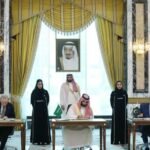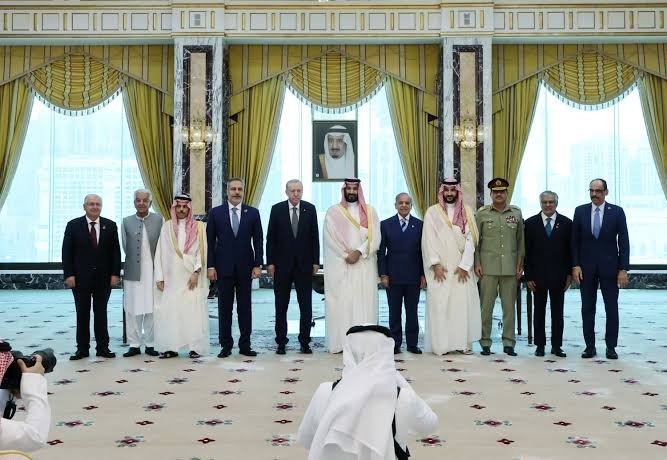
For years, discussions about Pakistan’s place in the global order have largely revolved around its economic vulnerabilities, political instability and dependence on external financing. But the Mecca Joint Defence Agreement signed by Pakistan, Saudi Arabia and Türkiye on August 7 offers a very different lens through which to view the country: Pakistan as a military and strategic power whose value increasingly extends far beyond South Asia.
The agreement commits the three countries to treating an armed attack against one as an attack against all. Türkiye’s Foreign Minister Hakan Fidan has compared its collective-defence principle to NATO’s Article 5, although the precise nature of military assistance would be determined through consultations. The agreement is officially defensive and, according to all three governments, is not directed against any particular country.
But the more interesting question is: why Pakistan?
Saudi Arabia brings enormous financial and energy influence. Türkiye brings NATO experience, geographic reach and an increasingly sophisticated defence industry. Pakistan brings something different: nuclear deterrence, a large professional military, extensive operational experience and decades of security cooperation with Gulf states.
Pakistan is also the only nuclear-armed Muslim-majority country. While the Mecca Agreement does not explicitly promise a Pakistani nuclear umbrella to Saudi Arabia or Türkiye — and such claims should therefore be treated cautiously — nuclear capability inevitably contributes to Pakistan’s overall strategic weight.
Its military relevance is not new.
Pakistan and Saudi Arabia have maintained close defence relations for decades, including military training and Pakistani deployments in the Kingdom. In September 2025, the two countries formalised that relationship further through their Strategic Mutual Defence Agreement, which similarly declared aggression against one country to be aggression against both. The International Institute for Strategic Studies described that agreement as part of wider changes linking the security dynamics of the Middle East and South Asia. (IISS)
What has changed is the international environment around Pakistan.
The country is increasingly attempting to translate military capability into defence-industrial influence. The Pakistan-China co-developed JF-17 fighter has become an important part of Islamabad’s defence diplomacy. Earlier this year, Reuters reported talks between Pakistan and Saudi Arabia over a potential multibillion-dollar arrangement involving JF-17 aircraft — evidence that their relationship is expanding beyond traditional military training into weapons and technology cooperation. (Reuters)
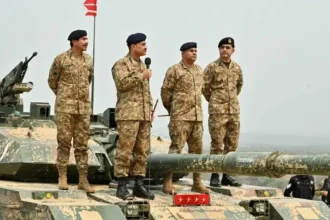
Pakistan also possesses something that cannot simply be purchased from an international arms manufacturer: institutional military experience. Its armed forces have operated across conventional warfare, counterterrorism, counterinsurgency and difficult mountainous and border environments. Generations of officers have also trained and worked with foreign militaries.
And this is where the Mecca Agreement becomes bigger than Pakistan.
It is another sign of an increasingly multipolar world.
For much of the post-Cold War era, Middle Eastern security was overwhelmingly organised around American military power. That architecture has not disappeared. Saudi Arabia remains closely tied to Washington, while Türkiye remains a NATO member.
But regional states are increasingly unwilling to place all their security bets on one great power.
Instead, countries are creating overlapping relationships: working with Washington while trading with Beijing, cooperating with regional powers while maintaining Western alliances, and developing security arrangements that do not necessarily require an American or European guarantor.
The Mecca Agreement fits squarely into that trend. Reuters describes the pact as part of a broader effort by regional powers to develop greater security autonomy amid profound Middle Eastern instability. (Reuters)
Perhaps this is therefore the most important takeaway.
Pakistan may not possess Saudi Arabia’s wealth or Türkiye’s economic size. But geopolitical power has never been determined by GDP alone.
Pakistan has nuclear weapons, strategic geography, a sizeable military, combat experience, defence-manufacturing ambitions and longstanding relationships across the Gulf.
The capability was always there. What is changing is the world’s demand for it.
And the Mecca Agreement may be one of the clearest indications yet that, in the emerging multipolar order, Pakistan intends to be more than a country reacting to global politics.
It intends to help shape them.